Path resurfacing deals with the two things that make a house feel neglected: lipped, uneven joints and green, slippery shade. The lip is ground flush, the joint replaced, the fall corrected, then a slip-rated finish is laid as one continuous surface. Most path work is narrow access, so it is hand work rather than machine work.
Pathways across South East Queensland
Side paths, entries and garden runs — narrow work where the finish and the falls matter more than the area.
Paths are small in area and high in visibility. They also collect the two problems that make a house feel neglected: green, slippery shade and lifted, uneven joints. Both get dealt with in a resurfacing job — grind the lip out, correct the fall, then lay a finish with grip.
For shaded southern paths we specify a higher slip rating and a sealer that resists organic growth. For entry paths we usually go the other way, using a border or a tile pattern to tie the path into the porch and the driveway.
Access is the whole trick on path work. Most of our path jobs are between a house and a fence with a metre of room, which rules out large machinery and rules in a crew that has done it a hundred times.
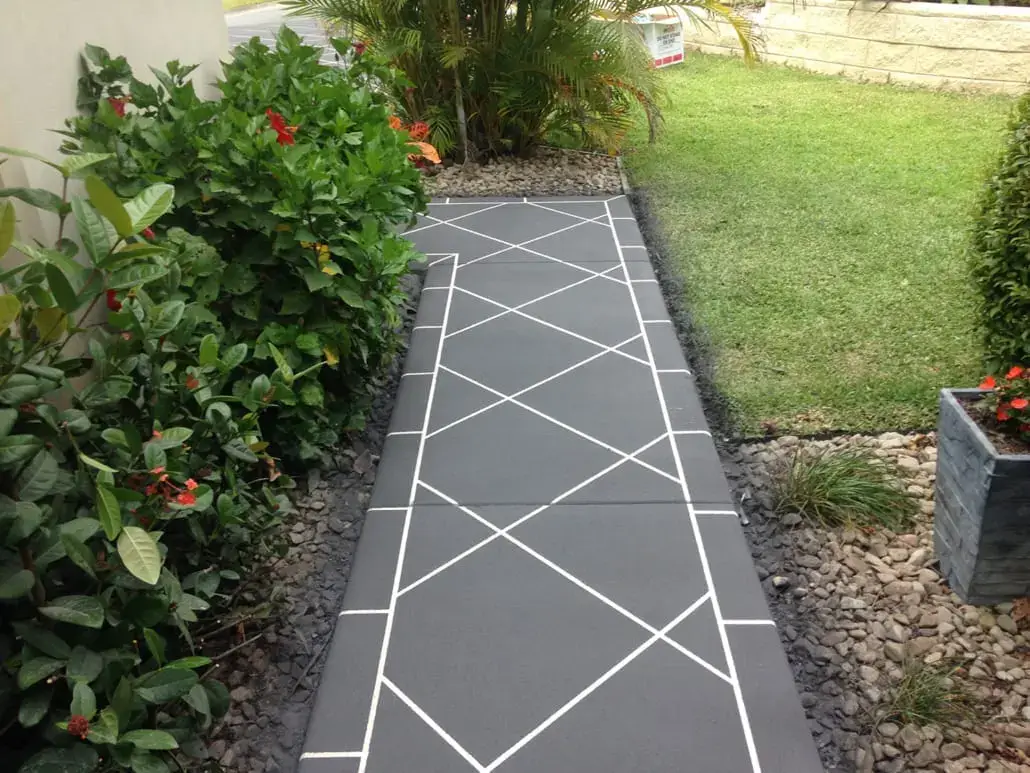
One of ours.
Prepared, laid and sealed by our own crew. Photographed after the sealer went down.
What we would lay here
Stencilled concrete
A paper stencil laid into the colour coat, sprayed over and lifted — leaving pattern joints in a second colour.
See finishPlain concrete
One colour, no cuts, no pattern. The finish that disappears and lets the house do the talking.
See finishExposed aggregate
Washed back to reveal the stone. The South East Queensland driveway default, and the most forgiving surface underfoot.
See finishColoured concrete
Full-strength oxide colour, with or without a cut pattern. Reads terracotta against brick and charcoal against render.
See finishThe questions we get asked
Can you fix a path that has lifted at the joints?
Yes — the lip is ground flush, the joint is cut and replaced, then the overlay goes over the top as a continuous surface.
Will a path finish match the driveway?
It can be laid in the same system and colour so the two read as one job, which is usually what people want.
Do you quote on site?
Always. The slab gets a test grind and a moisture check before anyone quotes a finish for it.
Guides for this job
Other applications
Send a photo of the slab.
We will tell you whether it can be resurfaced, what finish suits it, and what it costs — before anyone turns up with a grinder.