Can you resurface cracked concrete?
Nathan Carter · Decorative Concrete Resurfacing · Updated 24 August 2026Yes — cracked concrete can be resurfaced provided the crack is stable. It is saw-cut out to a clean profile, vacuumed, filled with flexible repair mortar and bridged with a reinforcing membrane before the overlay goes on. A crack that is still opening, closing or stepping is live, and no surface treatment will hold across it.
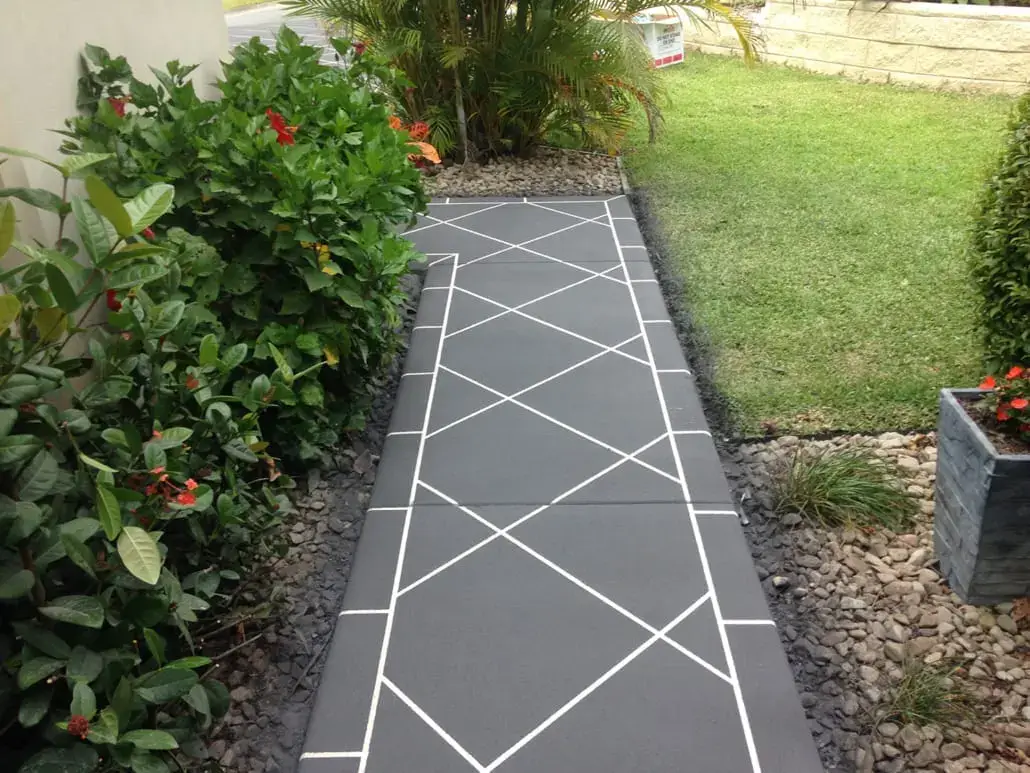
Cut, filled, bridged, then overlaid
A path finished over repaired concrete. The repair sits under the finish, not through it.
Photographed on one of our own jobs in South East Queensland.
Stable cracks versus live cracks
A stable crack has finished moving. It formed as the slab shrank and cured, or where a joint should have been cut and was not, and it has been the same width for years. That crack can be repaired and overlaid, and it stays gone.
A live crack is still working — opening in the dry, closing in the wet, or stepping vertically because one side is settling. Overlaying a live crack is the single most common cause of failed decorative work, because the fault reappears in the new surface within a season and looks worse for being in something new.
How a crack is actually repaired
Filler smeared into the top of a crack does nothing. The repair has to go into the crack and be able to move slightly with it.
- The crack is saw-cut or chased out to a clean, square profile — wider at the bottom of the cut than a knife-edge
- Dust is vacuumed out, because filler bonds to concrete, not to dust
- A flexible repair mortar is worked in and struck off flush
- A reinforcing membrane is bedded over the repair to bridge it, spreading any residual movement across a wider band
- Only then does the primer and the overlay go on
Crazing, spalling and other surface faults
Fine map cracking across the surface — crazing — is a surface phenomenon, not a structural one. It grinds out or gets buried under the overlay with no special treatment.
Spalling, where the surface has flaked away in patches, usually means the top few millimetres were weak from over-troweling or too much water in the original mix. Grinding removes the weak layer and the overlay replaces it. Where spalling has exposed reinforcement, the steel is treated and the section rebuilt before anything decorative happens.
What we do when the crack is live
We say so, in writing, before you spend anything on a finish. Then there are usually two options: cut out and replace the affected section and resurface the rest, or replace the slab.
Occasionally there is a third — install a proper control joint where the crack is, treat it as a designed movement joint rather than a defect, and lay the finish to that joint line so the slab has somewhere legitimate to move. That works when the crack is straight, stable in position, and in a place a joint could sensibly go.
Short answers
Will the crack show through the new surface?
Not if it was stable and was cut, filled and bridged. A crack that is still moving will eventually telegraph through any overlay, which is why the assessment matters more than the product.
How wide is too wide?
Width matters less than movement and step. A stable 5 mm crack is repairable; a 1 mm crack with a vertical step in it is a structural signal.
Can you repair cracks without resurfacing?
Yes — crack repair is a standalone service. The repair will be visible as a line, because it is one.
Written by the Decorative Concrete Resurfacing crew from work carried out across South East Queensland. Last reviewed . QBCC licence 1109935.
More in this cluster
Send a photo of the slab.
We will tell you whether it can be resurfaced, what finish suits it, and what it costs — before anyone turns up with a grinder.