A guide to stencilled concrete patterns
Nathan Carter · Decorative Concrete Resurfacing · Updated 24 August 2026Stencil pattern choice sets whether a slab reads as brick paving, tiling or stone. Running bond block suits brick houses; bushrock and crazy paving suit curves and slopes; diamond tile and hexagon suit render and contemporary facades; ashlar suits wide driveways. Scale the pattern to the area, and keep the joint colour close in tone to the field.
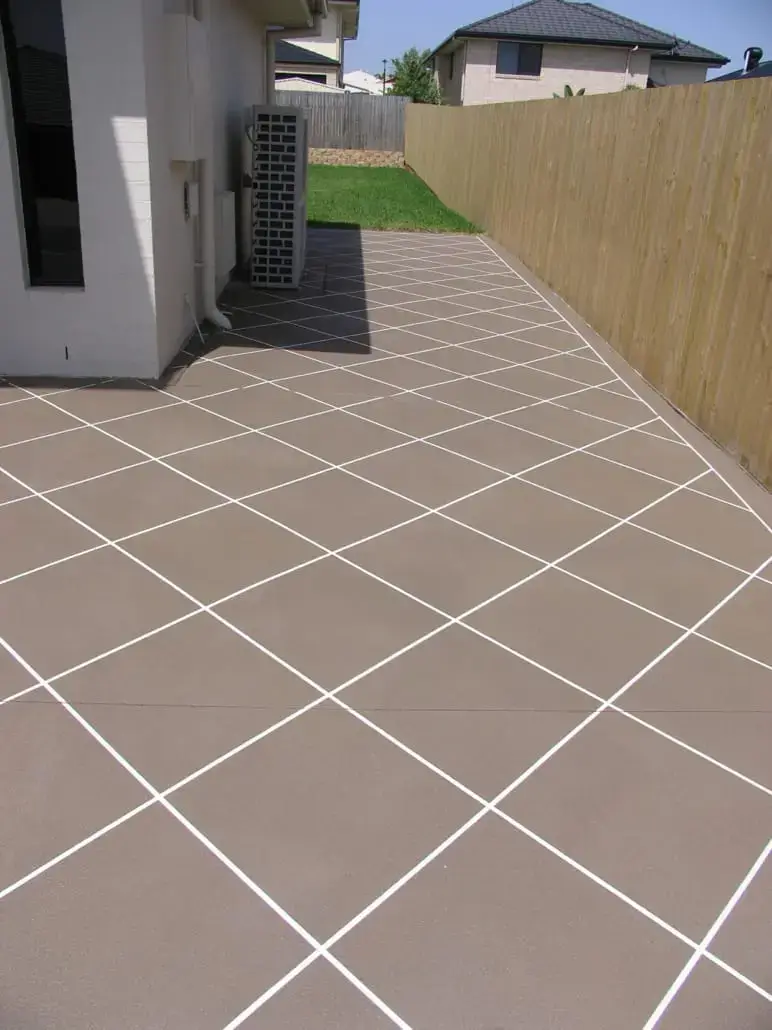
Diamond tile, two colours
Field colour and joint colour, with the stencil lifted while the coating is still green.
Photographed on one of our own jobs in South East Queensland.
How stencilling works
A single-use paper stencil is laid over the prepared, base-coloured slab. A second colour is sprayed across the top, and the stencil is lifted while the coating is still green. What is left is the field in colour two and the joint lines in colour one — a pattern that is part of the coating rather than a cut into it.
Because the joint is a colour change and not a physical gap, there is nothing to fill with weeds, nothing to lift, and nothing to re-sand. That is the practical advantage over real pavers, and it is why stencil work has stayed popular for thirty years.
The main patterns and what they suit
- Running bond block. Offset rectangles, brick-scale. Reads as brick paving. The safest choice against red, brown and mixed brickwork, which covers most Queensland housing stock.
- Bushrock and crazy paving. Irregular polygonal cells. Reads as stone. Best on curves, slopes and informal gardens where a regular grid would fight the geometry.
- Diamond tile. Octagon-and-square lattice on the diagonal. Reads as tiling. Suits rendered and contemporary houses, and pool surrounds where a formal look is wanted.
- Hexagon. Honeycomb. Contemporary, strongly geometric, best on smaller areas like courtyards and entries where it does not overwhelm.
- Ashlar and flagstone. Large rectangular or irregular slabs. Reads as cut stone, and holds up well on wide driveways where small patterns get busy.
Scale is the mistake people make
A pattern that looks right on a sample board can look fussy across sixty square metres. As a rule, the larger the area, the larger the pattern unit should be — small brick-scale patterns on a long acreage driveway turn into visual noise from the street.
The reverse applies too. A large ashlar pattern in a two-metre-wide side path gives you three stones and a lot of joint. We set out the pattern on your actual slab in chalk before laying, precisely so this is a decision you can see rather than imagine.
Colour pairs that work
Keep the joint colour close in tone to the field, not maximally contrasting. High contrast joints — near-white lines in a dark field — draw the eye to the pattern grid rather than the surface, and they show every imperfection in the layout.
Sandstone field with a warm grey joint against brick. Mid grey field with a charcoal joint against render. Terracotta field with a brown-grey joint on older brick and tile houses. Samples on site, against your own wall, in daylight.
Borders and inlays
A border in a third colour, or the same pattern run perpendicular around the perimeter, frames the field and makes a resurfaced driveway read as designed rather than coated. It is a small cost against the total.
Feature inlays — a compass, a monogram, a contrasting apron at the street — are hand-set work. They photograph beautifully and they date faster than a plain field, which is worth thinking about if you may sell.
Short answers
Do stencil joint lines wear away?
No. The joint is part of the coating and sits below the field colour, so sealer wears first.
Can you match my existing pavers?
Often closely. Pattern scale and both colours are chosen on site against the pavers or brickwork.
Can a stencil pattern go over an old stencil job?
Yes, after grinding the old coating back to a sound, keyed surface. The old pattern does not telegraph through once ground.
Written by the Decorative Concrete Resurfacing crew from work carried out across South East Queensland. Last reviewed . QBCC licence 1109935.
Related pages
More in this cluster
Send a photo of the slab.
We will tell you whether it can be resurfaced, what finish suits it, and what it costs — before anyone turns up with a grinder.