Epoxy or flake: choosing a garage floor
Nathan Carter · Decorative Concrete Resurfacing · Updated 24 August 2026Flake hides wear, dust and tyre marks and grips when wet, because the broadcast vinyl gives real texture; epoxy is flatter, cheaper as a single colour and shows every mark. Both are mechanically bonded, so both fail off a polished, sealed, damp or dirty slab. For a garage that doubles as a gym or workshop, flake with a polyurethane topcoat.
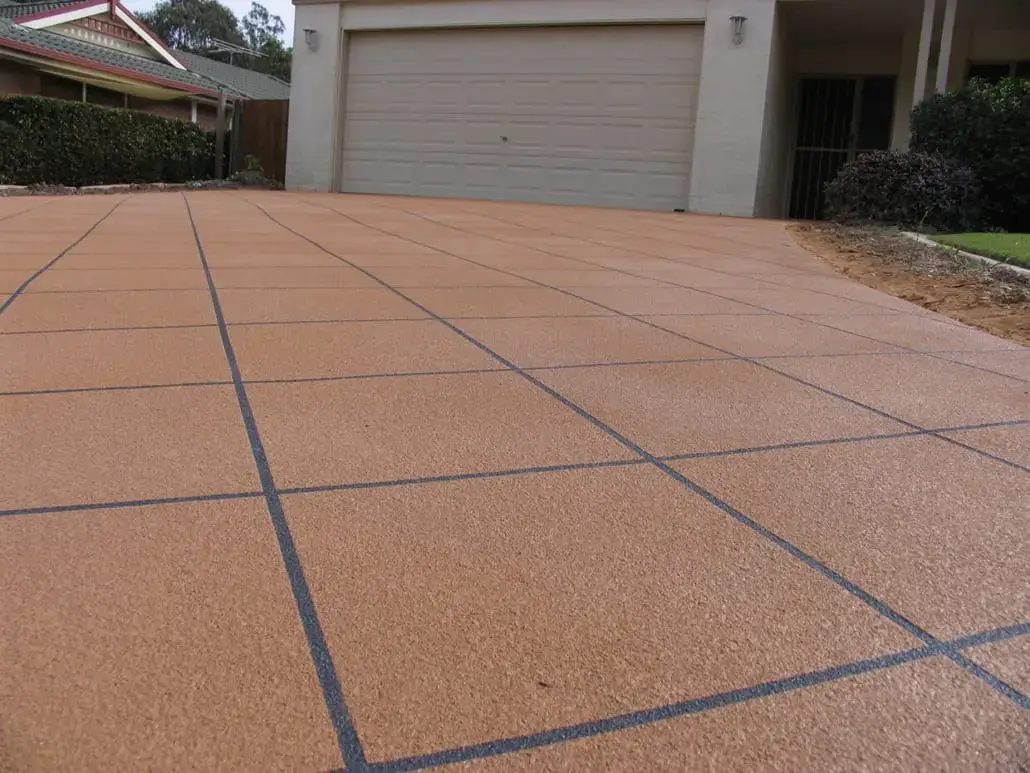
Garage floors take hot tyres
Which is why preparation and moisture testing decide between epoxy and flake.
Photographed on one of our own jobs in South East Queensland.
What each system is
Epoxy is a two-part resin rolled or squeegeed over prepared concrete, curing to a continuous, non-porous membrane. Solid colour, metallic effect or clear.
A flake system is built up in layers: a pigmented basecoat, coloured vinyl flake broadcast into it to refusal, the excess swept back, then two clear topcoats. The result has real texture and a speckled pattern.
How they compare in a real garage
- Hiding wear and dirt: flake wins comfortably. A solid epoxy floor shows every mark, tyre scuff and dust film. Flake reads as pattern.
- Slip resistance: flake, because the broadcast texture is inherent. Epoxy needs a grip additive to get there.
- Appearance: preference. Epoxy is sleek and showroom-flat; flake is terrazzo-like and busier.
- Cleaning: epoxy is marginally easier to mop, being flat. Both wash out with a hose or a mop.
- Cost: epoxy is generally cheaper as a single-colour system; flake costs more for the extra layers and labour.
- Repairability: flake blends better on a patch, because the pattern hides the join.
The part that decides both
Preparation. Both systems are mechanically bonded to the slab, and both fail off a slab that was polished, sealed, damp or dirty. That means diamond grinding to an open profile, vacuum extraction, moisture testing, priming and filling pinholes before any colour goes down.
Hot tyre pickup — where a patch of coating lifts with a warm tyre — is not a property of epoxy. It is a property of thin, poorly bonded epoxy, which is what most DIY kits produce over an unground slab.
What about outdoors?
Standard epoxy chalks and yellows in UV, so it does not belong outside. Where a resin finish is wanted in a carport or an exposed area, the topcoat needs to be a UV-stable polyurethane or aliphatic system — or the honest answer is a cementitious finish instead.
Inside a closed garage, UV is not a factor and either system performs.
Our default recommendation
For a garage that doubles as a gym, workshop or laundry — which is most of them — flake, with a polyurethane topcoat. It hides everything a family garage does to a floor, it has grip when wet, and it does not show every drop of oil as an event.
For a display or showroom space where the floor is meant to be seen and kept immaculate, solid or metallic epoxy.
Short answers
Will an epoxy floor peel?
Not off a correctly ground, dry, primed slab with a properly built system. Peeling and hot tyre pickup are preparation failures.
Is flake more slip resistant than epoxy?
Yes, inherently, because of the broadcast texture. Epoxy needs an additive to match it.
Can you coat a brand new slab?
It needs to cure first — around 28 days — and be moisture tested before coating.
Written by the Decorative Concrete Resurfacing crew from work carried out across South East Queensland. Last reviewed . QBCC licence 1109935.
Related pages
More in this cluster
Send a photo of the slab.
We will tell you whether it can be resurfaced, what finish suits it, and what it costs — before anyone turns up with a grinder.