Resurfacing or replacing: how to tell which one your slab needs
Nathan Carter · Decorative Concrete Resurfacing · Updated 24 August 2026Resurface when the slab is structurally sound: no rocking under load, no stepped or actively moving cracks, no rising damp, no rusting steel showing. Replace when any of those are present, because an overlay adds no structural capacity and the fault will reappear. Resurfacing costs roughly half as much and takes days rather than weeks.
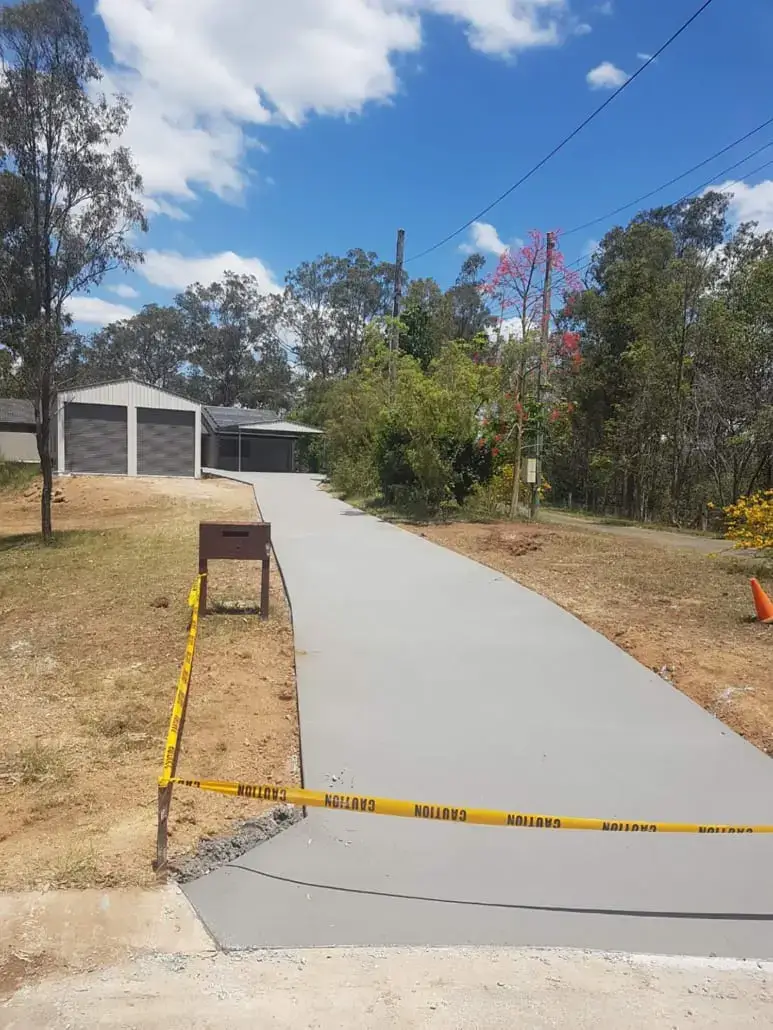
A slab worth keeping
Sound, level and structurally fine. Concrete like this is resurfaced, not removed.
Photographed on one of our own jobs in South East Queensland.
What resurfacing can and cannot fix
An overlay replaces the wearing surface. It fixes colour, texture, pattern, slip resistance, surface crazing, staining, chalking and worn-out patches. It can bridge cracks that have stopped moving, correct minor falls, and take a lipped joint back to flush.
It cannot add structural capacity. If the slab is too thin for what is driving on it, if it is sitting on fill that keeps settling, or if a crack is still opening and closing with the seasons, the overlay is a cosmetic layer over an ongoing problem.
The three tests we run before quoting
- Movement. We load the slab and watch the crack. A crack that opens, closes or steps under load is live, and no surface treatment will hold across it.
- Moisture. Rising damp or a slab sitting in permanent wet will push an overlay off from underneath. A moisture test takes minutes and saves whole jobs.
- Bond. A test grind shows what is actually on the slab — old sealer, glue, paint, laitance — and whether the concrete underneath is sound enough to bond to.
Signs that point to replacement
Cracks wider than roughly 5 mm that step vertically, sections that rock underfoot or under a car, edges crumbling along an entire boundary, exposed and rusting reinforcement, or a slab poured on uncompacted fill that has settled unevenly. Any of those and we will recommend removal and a new pour.
One honest note: a driveway with a single hairline crack and a chalky, faded surface is the most common thing we get asked to replace, and it is almost never the right call. That slab is fine. Its surface is not.
Cost, time and disruption compared
Resurfacing a sound slab typically lands near half the cost of replacement, runs two to three days on site for a residential driveway, and needs 24 hours before foot traffic and 72 before vehicles on most finishes.
Replacement means demolition, disposal, re-forming, re-pouring and roughly 28 days of curing before the slab takes its full service load — plus an excavator, a truck and a lot of dust on your property. The trade-off is that you get a new slab, with a new service life, rather than a new surface on an old one.
The middle option people forget
Slabs do not have to be treated as one unit. On plenty of jobs we remove and re-pour the failed section — a settled apron, a cracked landing, a corner that was always too thin — and resurface everything else, then lay the finish continuously across both so the repair does not read as a patch.
That is usually the best value outcome on an older property, and it only becomes visible as an option if someone tests the whole slab rather than pricing the obvious.
Short answers
Can you resurface over a crack?
Yes if the crack is stable. It is cut out, filled and bridged with a reinforcing membrane first. A live, moving crack is a different problem and needs a different answer.
How do I know if my slab is structurally sound?
It should not rock or deflect under load, cracks should be stable and not stepped, edges should be intact and there should be no rusting steel showing. We test all of that free before quoting.
Can part of a driveway be replaced and the rest resurfaced?
Yes, and it is often the best value option. The new section cures, then the finish is laid across the whole area so it reads as one surface.
Written by the Decorative Concrete Resurfacing crew from work carried out across South East Queensland. Last reviewed . QBCC licence 1109935.
More in this cluster
Send a photo of the slab.
We will tell you whether it can be resurfaced, what finish suits it, and what it costs — before anyone turns up with a grinder.