Commercial concrete resurfacing
Concrete that has to keep working while we work on it.
Commercial concrete resurfacing is the same method as residential with a different constraint: the surface has to keep working while it is being replaced. Jobs are staged in sections, run after hours or over weekends, and specified for traffic loading and slip rating rather than appearance. Car parks, warehouse floors, retail entries and strata driveways are the four common types, and each needs a different specification.
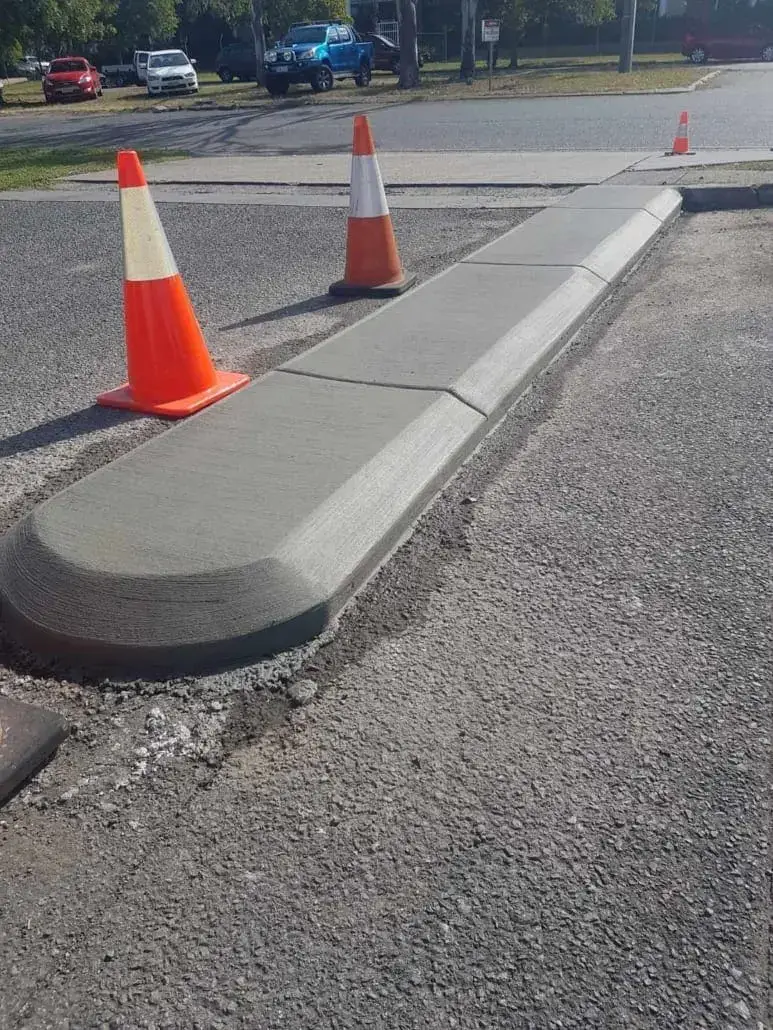
Hardstand, kerb and island work
Formed and finished around a trading site, staged so access is kept.
Photographed on one of our own jobs in South East Queensland.
What this covers
The technical method on a commercial slab is the same as on a driveway: grind back to sound concrete, test, repair, lay, seal. What changes is everything around it.
A trading site cannot close. A warehouse cannot stop receiving. Residents cannot be locked out of a basement. So the job gets planned as a staging problem first and a concrete problem second — which section, in what order, at what hour, with what still open.
Specification changes too. On a domestic driveway the client picks a finish and we rate it for slip. On a commercial slab the traffic decides: forklift tyres, delivery vehicles, constant low-speed turning and trolley wheels are all far harder on a surface than a family car, and a thin decorative overlay is simply the wrong product.
- Car parks, aprons and loading docks
- Warehouse and factory floors
- Retail, hospitality and shopfront entries
- Strata and body corporate driveways and ramps
- Line marking and bay reinstatement
- After-hours and staged programs
How a commercial job is run
| Staging | Work is sectioned so the site keeps operating. We agree the sequence in writing before mobilising rather than negotiating it on site. |
|---|---|
| Hours | After hours, overnight and weekend work where a hardstand or entry cannot close during trading. Priced into the quote, not added later. |
| Specification | Driven by traffic loading and slip rating, with the rating stated in writing. Decorative finishes are used only where the traffic allows them. |
| Documentation | QBCC licence, certificate of currency, written specification, SWMS and the staging program — all provided before work starts. |
The four commercial job types
They are genuinely different jobs and it is worth separating them. A car park is about slip rating on ramps, wear at turning points, and getting line marking reinstated accurately. A warehouse floor is about forklift traffic, joint condition and dust — where a failing joint does more damage than a worn surface. Retail and hospitality is about hours, hygiene and how fast an entry can reopen. Strata is about access, approvals and communication with residents who did not choose the work.
We quote each of those against its own constraints rather than applying one specification across all of them.
What usually goes wrong on commercial slabs
Contamination is the most common cause of failure. Years of oil, rubber and hydraulic fluid soak into a hardstand, and an overlay laid over that bonds to the contamination rather than the concrete. Degreasing and mechanical grinding are the fix, and skipping them is what makes a cheap quote cheap.
Joints are second. On a large slab the control joints do the work, and when a joint seal fails the edges spall under traffic and the damage accelerates. Reinstating joint seals is frequently better value than resurfacing the whole floor, and we will say so when it is.
Third is drainage. A commercial hardstand that ponds will keep ponding under a new surface, and it will show it faster. We assess fall before quoting a finish, because no sealer fixes standing water.
Four commercial clusters
Car parks and hardstands
Ramps, aprons, loading docks and bay reinstatement, staged so the car park keeps operating.
Read moreWarehouse and factory floors
Forklift traffic, joint seals and dust control on floors that cannot stop receiving.
Read moreRetail and hospitality
Shopfront entries, alfresco areas and back-of-house, turned around between trading days.
Read moreStrata and body corporate
Shared driveways, basement ramps and bin bays, staged so residents keep access.
Read moreThe questions we get asked
Can you work without closing our site?
Yes. That is the normal case. We stage in sections and work after hours or over weekends so the site keeps operating, with the sequence agreed in writing beforehand.
What slip rating do commercial ramps need?
A coarse, mechanically keyed slip-resistant finish — grip and wear come first on a ramp, and decorative finishes do not belong there. The rating goes on the quote.
Our hardstand is covered in oil. Does that matter?
A great deal. Oil must be degreased and mechanically ground out, or the overlay bonds to contamination instead of concrete. It is the step a cheap quote skips.
Do you reinstate line marking?
Yes. Bays, arrows, hatching and disabled bays are set out and reinstated as part of the program.
What documentation do you provide?
QBCC licence 1109935, certificate of currency, written specification, SWMS and the staging program, all before work starts.
Is resurfacing worth it on a worn warehouse floor?
Sometimes the joints are the problem rather than the surface, and resealing joints is far better value. We assess and tell you which — including when the answer is to do less than you asked for.
Worth reading first
Resurfacing at home?
Send a photo of the slab.
We will tell you whether it can be resurfaced, what finish suits it, and what it costs — before anyone turns up with a grinder.