Sealing is the last step of a resurfacing job and a standalone service in its own right. On a surface that is still sound, resealing restores colour and protection for a fraction of the cost of resurfacing. We use penetrating sealers where the slab needs to breathe and film sealers where gloss and stain resistance matter, with non-slip additives specified for pools and grades.
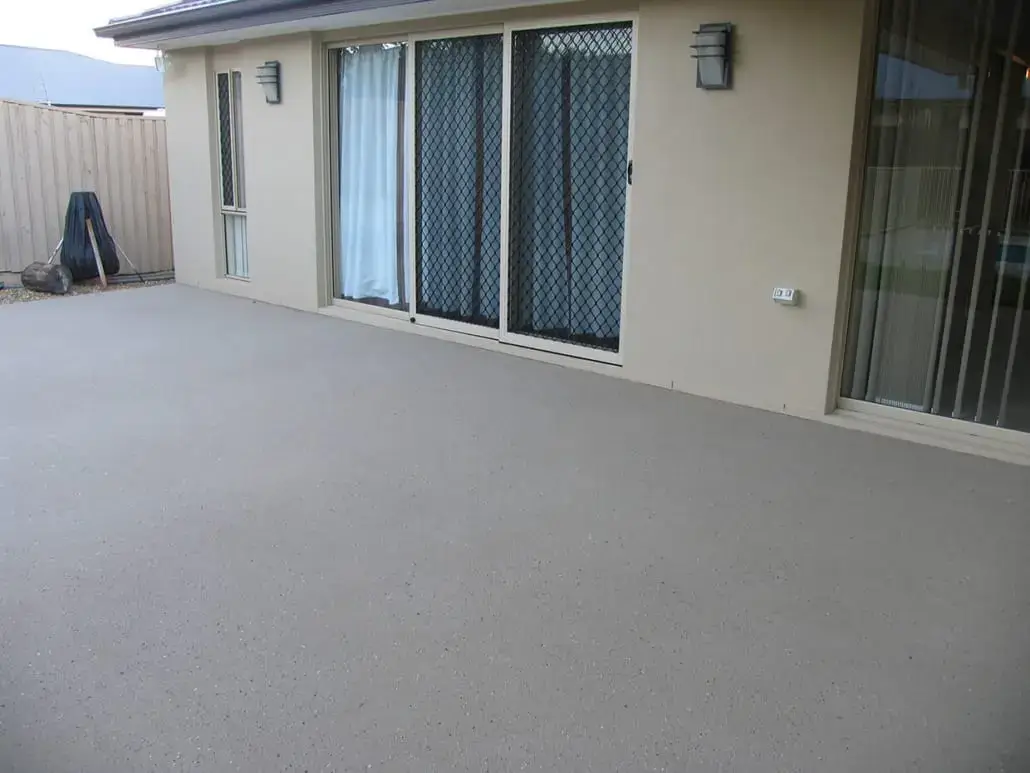
Two coats, UV stable
Sealer is the wearing layer — re-coating it is a fraction of a new finish.
Photographed on one of our own jobs in South East Queensland.
Concrete sealing in South East Queensland
The last step of every job, and a job on its own.
A sealer is not decoration. It is the layer that decides whether the surface underneath it absorbs oil, holds red soil, grows mould, or chalks off in the sun. Get it wrong and a perfectly laid finish looks tired in three years.
Sealing is also worth booking on its own. If your surface is sound and has simply gone flat and porous, resealing restores the colour and the protection at a fraction of the cost of resurfacing — and it is the single most under-used service we offer, because most people assume the only options are live with it or replace it.
We will tell you which of the two you need. If the surface itself has failed, sealing over it is throwing money at the symptom.
- Resealing sound existing surfaces
- Sealing new overlays and pours
- Penetrating sealers for damp and shaded slabs
- Film sealers for gloss and stain resistance
- Non-slip additives for pools and grades
- Stripping and replacing failed sealer
What we use, and when
| Penetrating sealers | Soak into the concrete and leave no surface film. The right choice on permanently damp or shaded slabs, and on coastal sites where a film would lift. Matte finish, breathable, no gloss. |
|---|---|
| Film-forming sealers | Sit on top as a thin coating. Better colour enhancement, better stain resistance, a range of gloss levels. Wrong on a slab that cannot dry out from below. |
| Non-slip additives | Fine aggregate suspended in the sealer to raise the wet slip rating. Specified as a rating, not as the word "non-slip", on pool surrounds and any real grade. |
| Reseal interval | Longer inland, shorter near salt water, shorter again in full sun. We give you a realistic interval for the actual product rather than a marketing figure. |
Choosing between penetrating and film
This is the decision that matters and it is decided by the slab, not by preference. A slab that stays damp — heavy shade, poor drainage, no membrane underneath, or simply new and still curing — pushes moisture upward. A film sealer traps that moisture and eventually blisters or goes cloudy. A penetrating sealer lets the slab breathe while still resisting staining.
Where the slab is dry and stays dry, film sealers are the better product: they enhance colour, resist stains more effectively, and can be specified from matte through to high gloss.
We moisture test before recommending either. It takes minutes and it is the difference between a sealer that lasts and one that fails without ever being at fault.
When resealing is the whole job
If the surface is intact but dull, chalky, or absorbing marks, the finish has not failed — the sealer has. Grinding off a sound finish to lay a new one is wasteful. A clean, a light abrasion, and a fresh sealer gives you most of the appearance back for a small fraction of the cost.
What resealing cannot do is fix a failing surface. If the finish is delaminating, cracking through, or lifting in patches, sealing over it locks the failure in. We will tell you which situation you are in at the quote, including when the answer is that you need less work than you asked for.
Slip rating, in writing
Around a pool and on any real grade, the sealer determines how the surface behaves wet. We specify a rating — R11 as a minimum around water, R12 where there are steps or fall — and it goes on the quote as a number.
The reason we insist on the number is that "non-slip" is not a specification. A surface can feel grippy dry and be genuinely dangerous under a wet bare foot, and the only way to hold anyone to account for that is a rating.
The questions we get asked
Can you just reseal instead of resurfacing?
Often, yes — and it is a fraction of the cost. If the surface is sound and has just gone dull and porous, resealing restores it. We will tell you honestly which you need.
How often does concrete need resealing?
Depends on exposure: longer inland, shorter near salt water, shorter again in full sun. We give you a realistic interval for the specific product rather than a headline number.
Penetrating or film sealer — which is better?
Neither. It depends on whether the slab can dry out. Damp or shaded slabs need a penetrating sealer or a film will blister. Dry slabs do better with a film.
Can you make an existing surface less slippery?
Yes, usually at reseal. Non-slip additives raise the wet slip rating without resurfacing, and we quote it as a rating rather than a promise.
Our sealer has gone cloudy. Can it be fixed?
Cloudiness is usually moisture trapped under a film sealer. It has to come off and be replaced with a breathable product — sealing over it again makes it worse.
How long before we can use it?
Foot traffic at 24 hours, vehicles at 72 for most sealers. Full chemical cure takes longer and we will tell you when to avoid harsh cleaning.
Send a photo of the slab.
We will tell you whether it can be resurfaced, what finish suits it, and what it costs — before anyone turns up with a grinder.