Stencilled concrete puts a paper pattern over the base colour, sprays a second colour across it and lifts the stencil while the coating is green, leaving joint lines in the first colour. Build-up is 2–3 mm; foot traffic at 24 hours, vehicles at 72. Because the joint is a colour change rather than a gap, there is nothing to weed or re-sand.
Stencilled concrete in Brisbane and Ipswich
A paper stencil laid into the colour coat, sprayed over and lifted — leaving pattern joints in a second colour.
Stencilling is how a flat slab becomes paving. A single-use pattern stencil is laid over the base colour, a second colour is sprayed across it, and the stencil is lifted while the coating is still green — leaving crisp joint lines in the base colour underneath.
Pattern choice changes the whole character of a driveway. Running bond block reads as brick paving and suits traditional houses. Diamond tile and hexagon patterns read as tiling and suit render and modern facades. Bushrock and crazy paving read as stone and work best on curved or sloping ground where a regular grid would fight the geometry.
Because the joint is a colour change rather than a cut, there is nothing for weeds to grow in and nothing to lift. It is the lowest-maintenance way to get a paved look over an existing slab.
Stencilled concrete, by the numbers
Figures are for a standard residential job in South East Queensland conditions. Your quote states the build-up for your slab.
| Build-up | 2–3 mm |
|---|---|
| Foot traffic | 24 hours |
| Vehicles | 72 hours |
| Slip rating | R10 |
| Patterns | Running bond, diamond tile, bushrock, hexagon, ashlar |
| Colours | Two — field and joint |
Where this finish belongs
These are the situations where we would put stencilled concrete forward without being asked for it.
- Brick houses, where running bond or bushrock patterns pick up the masonry
- Driveways where a paved look is wanted without the joints of real pavers
- Curved and sloping areas, where irregular patterns suit the geometry
- Pool surrounds and patios where a formal tile pattern reads well
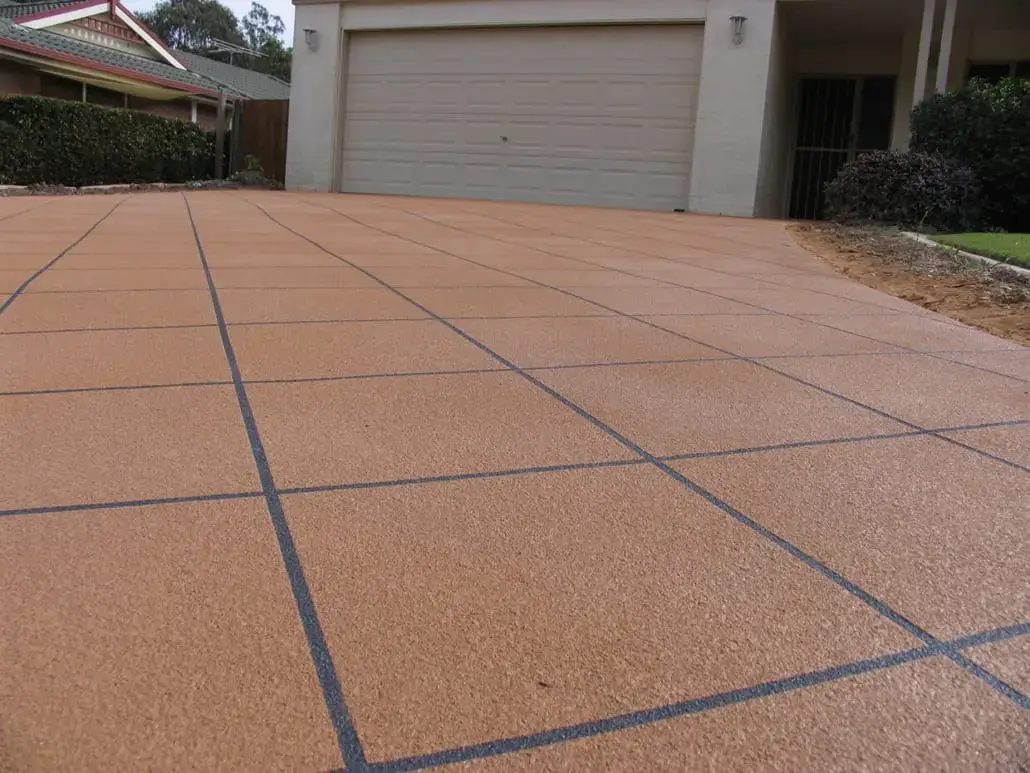
This is the actual finish.
Photographed on a job, sealed, in daylight. We bring samples to the quote so you can see it against your own brick and render.
Where we would not use it
Small-unit patterns get busy across very large areas — on long driveways we scale the pattern up or move to ashlar.
If your job falls into that category we will say so at the quote and put up the finish that does suit it, rather than selling you the one you asked about.
Looking after it
The pattern is part of the coating, not a cut, so there is nothing to weed or re-sand. Maintenance is the sealer and nothing else. Keep leaf litter off shaded sections, because organic staining sits in the joint lines where it is most visible.
Full detail, including re-seal intervals by exposure and safe cleaning pressures, is in the sealing and maintenance guide.
The questions we get asked
Do the joint lines wear off?
The joint is part of the coating, not a paint line, and it sits below the field colour. Sealer wears before the pattern does.
Can you match existing pavers or brickwork?
Often closely — pattern scale and both colours are chosen on site against the existing brick or paving.
Can I see it before committing?
Yes. Samples come to the quote, and we can usually point you at a job in your suburb to drive past.
How often will it need re-sealing?
Every three to five years in full sun and around five to seven under cover. The sealer is the wearing layer and re-coating it is a fraction of the cost of a new finish.
Guides on this finish
Send a photo of the slab.
We will tell you whether it can be resurfaced, what finish suits it, and what it costs — before anyone turns up with a grinder.