A plain concrete overlay is a single-colour cementitious coating, 3–4 mm thick, trowelled over the prepared slab and sealed with no pattern or cuts. Foot traffic at 24 hours, vehicles at 72, slip rating around R11. It suits contemporary and rendered houses, and it is the easiest finish to patch or extend years later.
Plain concrete in Brisbane and Ipswich
One colour, no cuts, no pattern. The finish that disappears and lets the house do the talking.
A plain overlay is a cementitious coating sprayed and trowelled over the prepared slab in a single colour, then sealed. There is no stencil, no tile line and no aggregate — just an even, slightly textured surface that reads as new concrete rather than as a decorative treatment.
It suits modern houses where a pattern would fight the architecture, and it is the most forgiving finish years later: a patch or an extension blends in far more easily than it would across a tiled or stencilled field.
Texture is set by how the coating is finished — from a fine sponge float for a soft, near-flat surface to a light broom for more grip on a slope.
Plain concrete, by the numbers
Figures are for a standard residential job in South East Queensland conditions. Your quote states the build-up for your slab.
| Build-up | 3–4 mm |
|---|---|
| Foot traffic | 24 hours |
| Vehicles | 72 hours |
| Slip rating | R11 |
| Colour | Single oxide, full range |
| Sealer | Two coats, UV stable |
Where this finish belongs
These are the situations where we would put plain concrete forward without being asked for it.
- Contemporary and rendered houses where a pattern would compete with the architecture
- Large areas that will later be extended or patched — it blends better than any patterned finish
- Shaded courtyards and side paths, where texture can be lifted for grip
- Garage aprons and utility areas where the surface should simply disappear
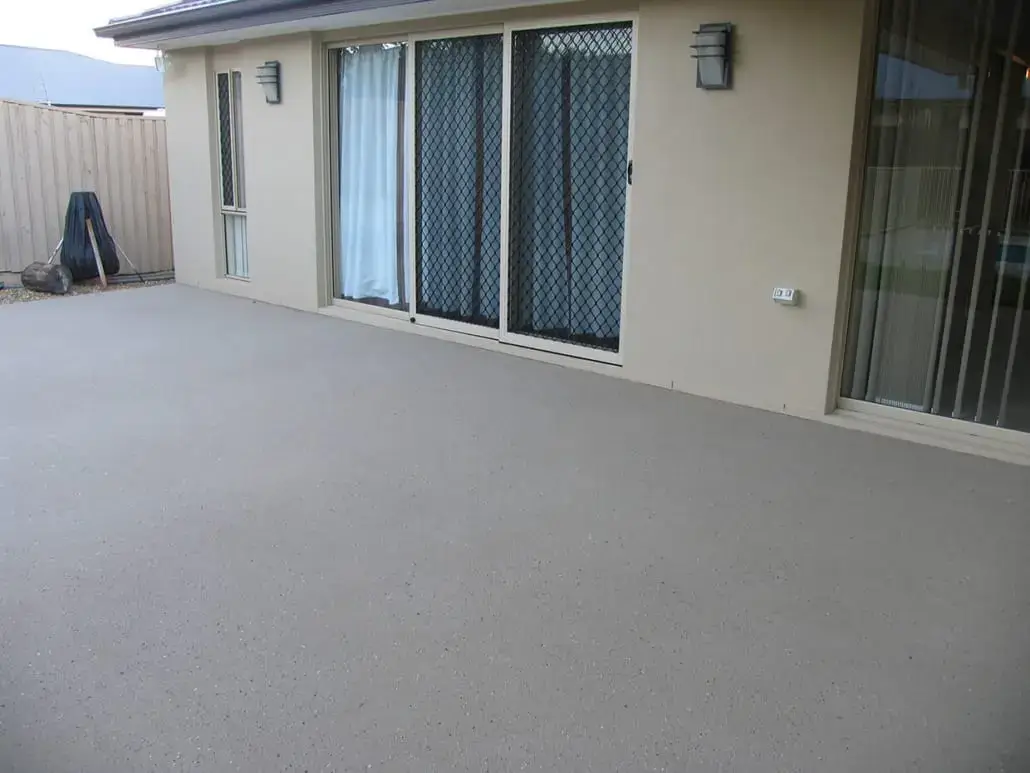
This is the actual finish.
Photographed on a job, sealed, in daylight. We bring samples to the quote so you can see it against your own brick and render.
Where we would not use it
On a steep driveway we would specify texture up, or move to aggregate — a smooth plain finish on a fall is the wrong call.
If your job falls into that category we will say so at the quote and put up the finish that does suit it, rather than selling you the one you asked about.
Looking after it
Plain finishes show marks more readily than speckled ones, so a quick hose down is worth doing more often. Re-seal every three to five years in full sun; the colour is oxide through the coating, so what dulls is the sealer, not the pigment.
Full detail, including re-seal intervals by exposure and safe cleaning pressures, is in the sealing and maintenance guide.
The questions we get asked
Will it look like a painted driveway?
No. It is a trowelled cementitious layer with real texture and thickness, not a film sitting on top of the slab.
Can a plain overlay be patterned later?
Cuts can be added, but the join will show. If you want a pattern, it is cheaper and cleaner to do it in the original lay.
Can I see it before committing?
Yes. Samples come to the quote, and we can usually point you at a job in your suburb to drive past.
How often will it need re-sealing?
Every three to five years in full sun and around five to seven under cover. The sealer is the wearing layer and re-coating it is a fraction of the cost of a new finish.
Guides on this finish
Send a photo of the slab.
We will tell you whether it can be resurfaced, what finish suits it, and what it costs — before anyone turns up with a grinder.