Vinyl flake flooring is built up in layers: a pigmented basecoat, coloured flake broadcast to refusal, then two clear topcoats — about 1–1.5 mm total, around R11. Foot traffic at 24 hours, vehicles at 72. The broadcast texture gives grip when wet and hides dust, tyre marks and slab variation better than any solid colour.
Flake flooring in Brisbane and Ipswich
Vinyl flake broadcast into a resin basecoat and sealed under clear topcoats — the durable garage floor that hides everything.
Flake systems are built up in layers: a pigmented basecoat, coloured vinyl flake broadcast into it to refusal, the excess swept back, then two clear topcoats. The finished floor has genuine texture, real slip resistance, and a speckled pattern that hides dust, tyre marks and minor slab variation better than any solid colour.
Flake size and blend set the look — a fine grey-and-white blend reads almost like terrazzo, while a larger multi-colour flake reads unmistakably as a workshop floor. Both are hard-wearing and both clean with a mop.
It is our default recommendation for garages that double as gyms, laundries or workshops: comfortable, non-slip, and forgiving of everything that gets dropped on it.
Flake flooring, by the numbers
Figures are for a standard residential job in South East Queensland conditions. Your quote states the build-up for your slab.
| Build-up | 1–1.5 mm |
|---|---|
| Foot traffic | 24 hours |
| Vehicles | 72 hours |
| Slip rating | R11 |
| Flake | Fine, medium or large; custom blends |
| Topcoat | Two clear coats, UV stable option |
Where this finish belongs
These are the situations where we would put flake flooring forward without being asked for it.
- Garages that double as gyms, workshops or laundries
- Floors that need grip when wet without an added grit
- Areas where dust, tyre marks and minor slab variation should disappear
- Jobs where a patch may be needed later — the pattern hides the join
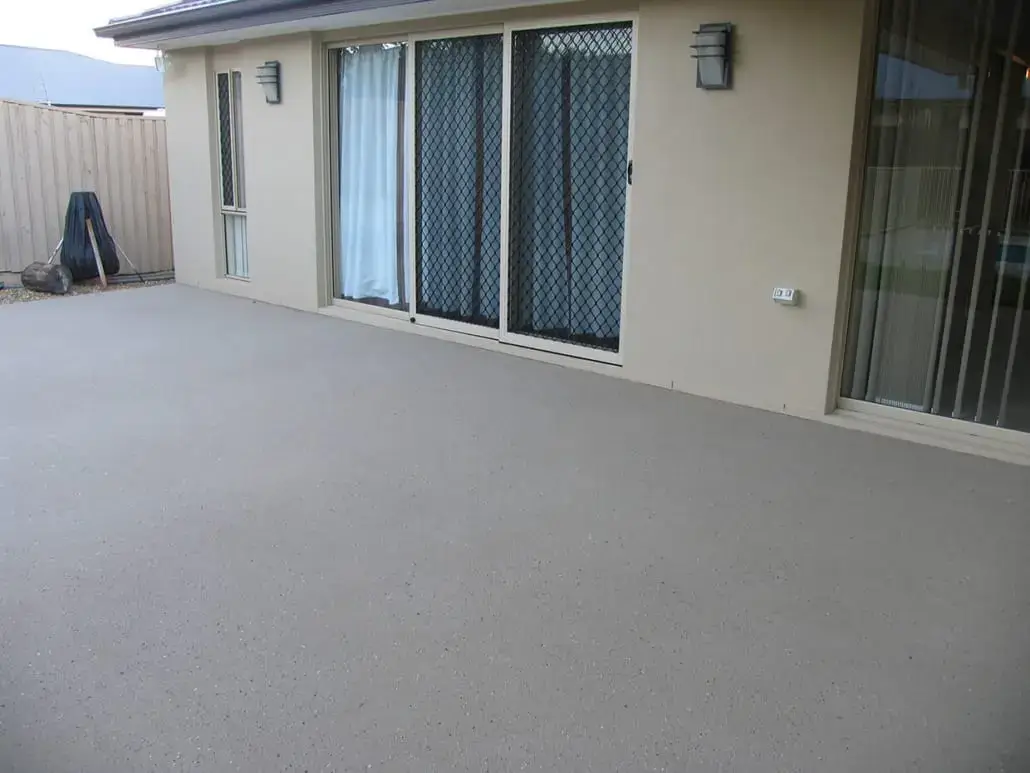
This is the actual finish.
Photographed on a job, sealed, in daylight. We bring samples to the quote so you can see it against your own brick and render.
Where we would not use it
Large flake blends can look busy in small interior rooms; we drop to a fine blend where the floor is part of a living space.
If your job falls into that category we will say so at the quote and put up the finish that does suit it, rather than selling you the one you asked about.
Looking after it
Mop or hose. The clear topcoats are the wearing layer and can be re-coated after grinding back the sheen, which is far cheaper than replacing the system. Furniture pads and wheel mats are worth using where a single point takes constant load.
Full detail, including re-seal intervals by exposure and safe cleaning pressures, is in the sealing and maintenance guide.
The questions we get asked
Is flake better than plain epoxy for a garage?
For most homes, yes — it hides wear, adds grip, and does not show every mark the way a solid colour does.
Can hot tyres lift it?
Not with a correctly primed system and a polyurethane topcoat. Hot tyre pickup is a symptom of thin, single-coat DIY kits.
Can I see it before committing?
Yes. Samples come to the quote, and we can usually point you at a job in your suburb to drive past.
How often will it need re-sealing?
Every three to five years in full sun and around five to seven under cover. The sealer is the wearing layer and re-coating it is a fraction of the cost of a new finish.
Guides on this finish
Send a photo of the slab.
We will tell you whether it can be resurfaced, what finish suits it, and what it costs — before anyone turns up with a grinder.