A coating is a material laid on top of a slab to change how it performs and how it looks — epoxy, polyurethane, vinyl flake, or a trowelled cement overlay. Which one is right depends on the traffic, the moisture in the slab and whether the surface is indoors or in UV. Every coating is only as good as the preparation underneath it, which is why we grind rather than etch.
Coatings have thickness
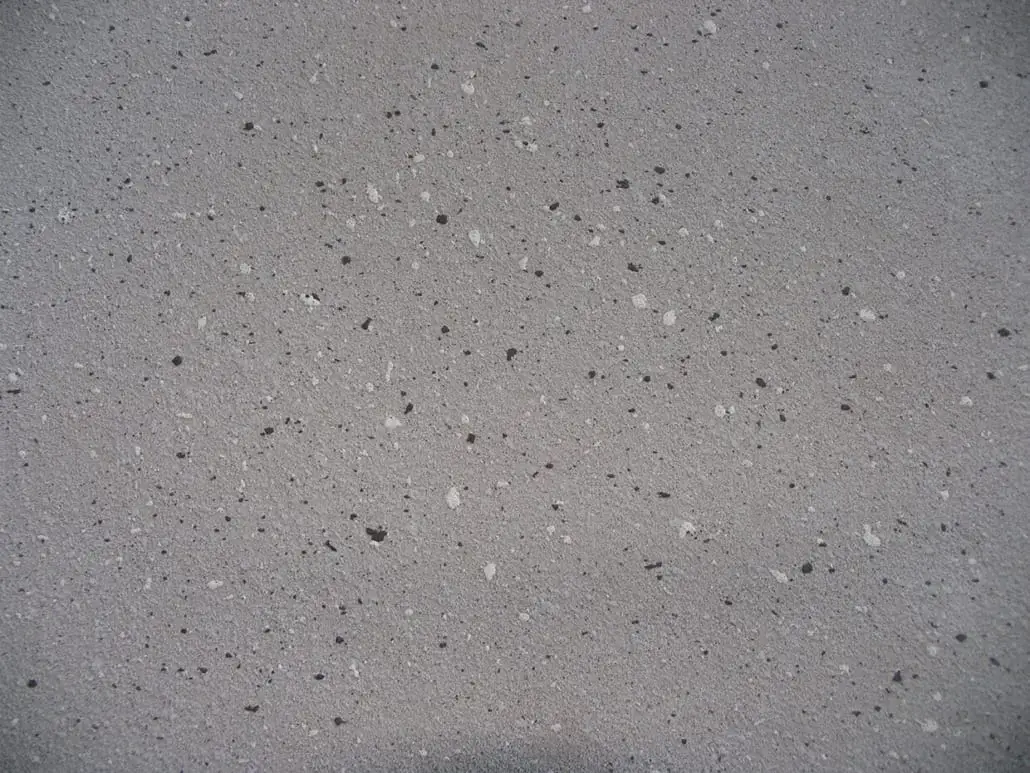
A sprayed speckle coating, built to a consistent depth and sealed.
Photographed on one of our own jobs in South East Queensland.
Concrete coatings in South East Queensland
Epoxy, polyurethane, vinyl flake and cement overlays — matched to the traffic.
Coating is the broad term for anything laid over a slab to change its performance: resin systems like epoxy and polyurethane, decorative systems like vinyl flake, and cement-based overlays like the spray-on and trowelled finishes used on driveways.
They are not interchangeable. Epoxy is hard and chemically resistant but yellows in UV. Polyurethane holds colour outdoors and is more flexible. Vinyl flake hides dust and tolerates movement. A cement overlay is the only one of them that genuinely looks like concrete, because it is.
What they all share is total dependence on preparation. A coating bonds to the profile of the concrete, not to the curing compound, laitance, glue or old sealer sitting on it. That is why every job starts with mechanical grinding under vacuum extraction rather than an acid etch.
- Epoxy floor coatings
- Polyurethane topcoats for UV exposure
- Vinyl flake systems
- Cement-based spray and trowel overlays
- Moisture-tolerant primers and barriers
- Coating removal and re-coating
What we use, and when
| Epoxy | Hard, chemically resistant, seamless. Best indoors — garages, workshops, plant rooms. Yellows under UV, so outdoor use needs a polyurethane topcoat. |
|---|---|
| Polyurethane | More flexible than epoxy and UV stable, so it holds colour outdoors. Commonly used as the topcoat over an epoxy build rather than on its own. |
| Vinyl flake | Flake broadcast into resin and sealed. Hides dust and tyre marks, tolerates slab movement, and gives a genuine slip rating. The most forgiving garage floor. |
| Cement overlay | Two to four millimetres of cement-based material, sprayed or trowelled, then coloured and sealed. The only coating that reads as concrete, and the standard for driveways. |
Preparation decides everything
Almost every coating failure we are called to inspect is a bond failure, and almost every bond failure traces to preparation. A slick trowelled surface, a curing compound, an old sealer or a layer of laitance will all stop a coating keying in — and none of them are removed by acid etching, which is the shortcut that makes a cheap quote cheap.
We grind mechanically under vacuum extraction until the concrete is clean, open and sound. On contaminated slabs — garage oil, workshop hydraulic fluid, commercial hardstand — that includes degreasing first, because a coating laid over oil bonds to the oil.
Moisture, and why it lifts coatings
Concrete releases water for months after it is poured, and a slab without a membrane under it keeps drawing moisture from the ground indefinitely. Seal a coating over either and the water has nowhere to go but into the bond line, where it eventually pushes the coating off in sheets.
We moisture test before coating, every time. Where the reading is high, the answer is either to wait or to use a moisture-tolerant primer or barrier system — both of which are cheaper than doing the floor twice.
Indoors, outdoors and UV
The most common specification mistake is a straight epoxy outdoors. Epoxy is an excellent floor coating and it ambers noticeably under Queensland UV, which on a white or light grey floor is very visible within a year or two.
Outdoors we either topcoat with a UV-stable polyurethane or use a cement-based overlay, which has no resin binder at the surface to discolour in the first place. That is a large part of why driveways here are overlays rather than resin systems.
The questions we get asked
What is the difference between a coating and a sealer?
A coating is a material laid on to change the surface — thickness, colour, texture, wear. A sealer is a thin protective layer over whatever is already there. Coatings replace a surface; sealers protect one.
Will epoxy work on my driveway?
Not on its own. Epoxy ambers under Queensland UV and it will be visible within a year or two. Outdoors we topcoat with polyurethane or use a cement-based overlay instead.
Why do you grind instead of acid etching?
Because etching does not remove curing compound, old sealer, glue or laitance, and a coating will not bond through any of those. Grinding is the difference between a coating that stays on and one that peels.
My garage floor coating is peeling. Why?
Almost always bond failure — either preparation or moisture. Both mean the old coating comes off before a new one goes on; coating over a peeling floor fails again.
Can you coat a new slab?
Once it has released enough moisture, yes. We moisture test and will tell you to wait if the reading says so. A moisture-tolerant primer is the alternative where waiting is not possible.
Does a coating add slip resistance?
It can, and it should be specified as a rating. Vinyl flake gives genuine texture; smooth epoxy on its own is slippery wet.
Send a photo of the slab.
We will tell you whether it can be resurfaced, what finish suits it, and what it costs — before anyone turns up with a grinder.