How long before you can walk and drive on it
Nathan Carter · Decorative Concrete Resurfacing · Updated 24 August 2026On sprayed, stencilled, plain and coloured finishes: foot traffic at 24 hours and vehicles at 72. Exposed aggregate needs 72 hours for foot traffic and seven days for vehicles; stamped work 48 hours and seven days. Cool, humid weather extends all of it. Treat wheelie bins, trailers and jockey wheels as vehicles, not foot traffic.
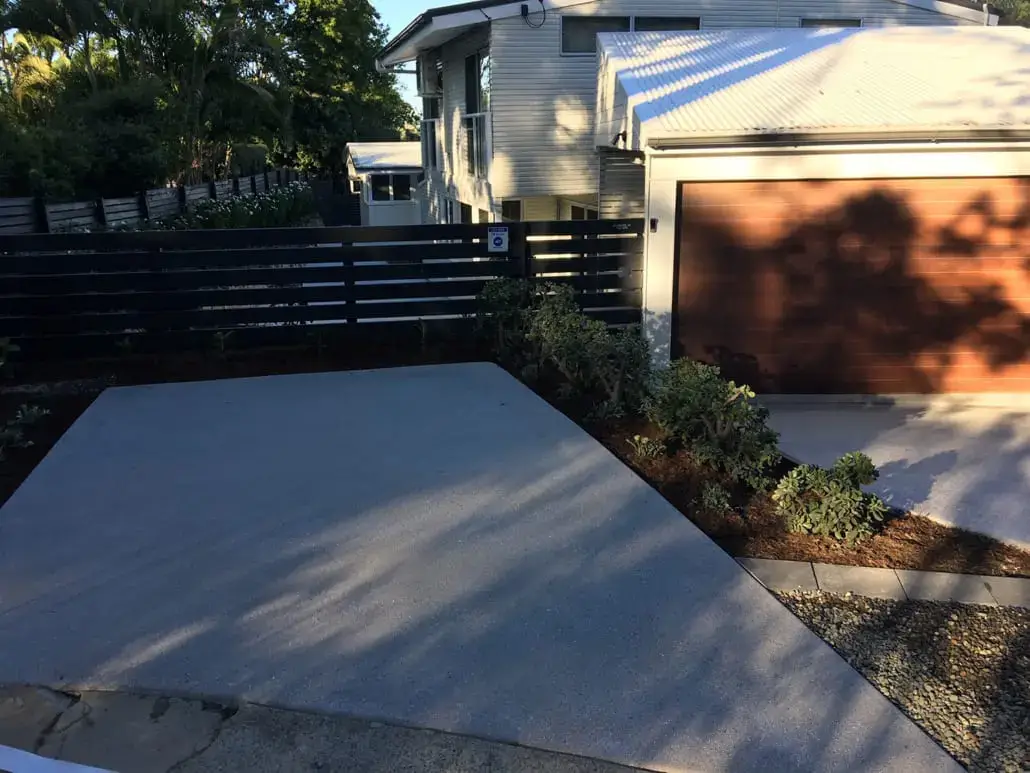
Aggregate needs the longest wait
Exposed aggregate takes 72 hours for foot traffic and seven days for vehicles.
Photographed on one of our own jobs in South East Queensland.
The standard figures
For sprayed, stencilled, plain and coloured cementitious finishes: foot traffic at 24 hours after sealing, vehicles at 72 hours. Those are the figures we put on quotes and they hold in normal South East Queensland conditions.
For exposed aggregate: foot traffic at 72 hours, vehicles at seven days. For stamped and timber look overlays: foot traffic at 48 hours, vehicles at seven days where vehicles are appropriate at all. Both are thicker, wet-cast systems and they cure from the surface inward.
Cure times by finish
| Finish | Foot traffic | Vehicles |
|---|---|---|
| Sprayed speckle / Covercrete | 24 hours | 72 hours |
| Plain and coloured overlay | 24 hours | 72 hours |
| Stencilled and tile finishes | 24 hours | 72 hours |
| Exposed aggregate | 72 hours | 7 days |
| Stamped concrete | 48 hours | 7 days |
| Timber look | 48 hours | Not recommended |
| Epoxy and flake floors | 24 hours | 72 hours |
| Polished concrete | 24 hours after sealing | 48–72 hours |
Why rushing it costs money
A surface that looks hard is not necessarily cured. Driving on a coating that has not developed strength scuffs the sealer, marks the finish under turning tyres, and breaks up edges where the load concentrates. None of that is repairable without re-coating the area.
The most common damage we see from early use is a set of tyre scuff arcs where somebody reversed a car in a three-point turn a day early. It is permanent, and it is visible from the street.
Weather and the clock
Cure times assume dry weather and normal temperatures. Cool, humid and overcast conditions extend them — in a wet July week, add a day to everything. Very hot weather does not speed curing up so much as it risks the surface drying too fast, which is why we work early and keep surfaces shaded where we can.
Rain within the first few hours after sealing is the worst case, and it is why we watch the forecast rather than the calendar.
Planning around it
If the driveway is your only access, tell us at quote time. Long driveways can be staged in halves so you keep a lane. Shared or body corporate driveways get scheduled around resident access, sometimes out of hours.
Park the caravan, trailer or boat somewhere else for the week. Point loads on a green surface leave dents, and jockey wheels are the classic culprit.
Short answers
Can I walk on it the same day?
No. Twenty-four hours for foot traffic on most finishes, longer on aggregate and stamped work.
What if it rains right after sealing?
Rain in the first hours can blush or mark the sealer. We do not seal into a wet forecast, and if we are caught out we recoat rather than leave it.
When can I put the bins back on it?
Treat wheelie bins as vehicles, not foot traffic — the same 72 hours, and roll them rather than dragging.
Written by the Decorative Concrete Resurfacing crew from work carried out across South East Queensland. Last reviewed . QBCC licence 1109935.
Related pages
More in this cluster
Send a photo of the slab.
We will tell you whether it can be resurfaced, what finish suits it, and what it costs — before anyone turns up with a grinder.