The best driveway finish for the Brisbane climate
Nathan Carter · Decorative Concrete Resurfacing · Updated 24 August 2026For South East Queensland driveways, exposed aggregate performs best overall: about R12 slip resistance, a stone wearing surface, and it hides dirt and tyre marks. Stencilled finishes give the best value paved look over an existing slab. UV stability in the sealer and correct falls matter more than the pattern, and slope decides slip rating first.
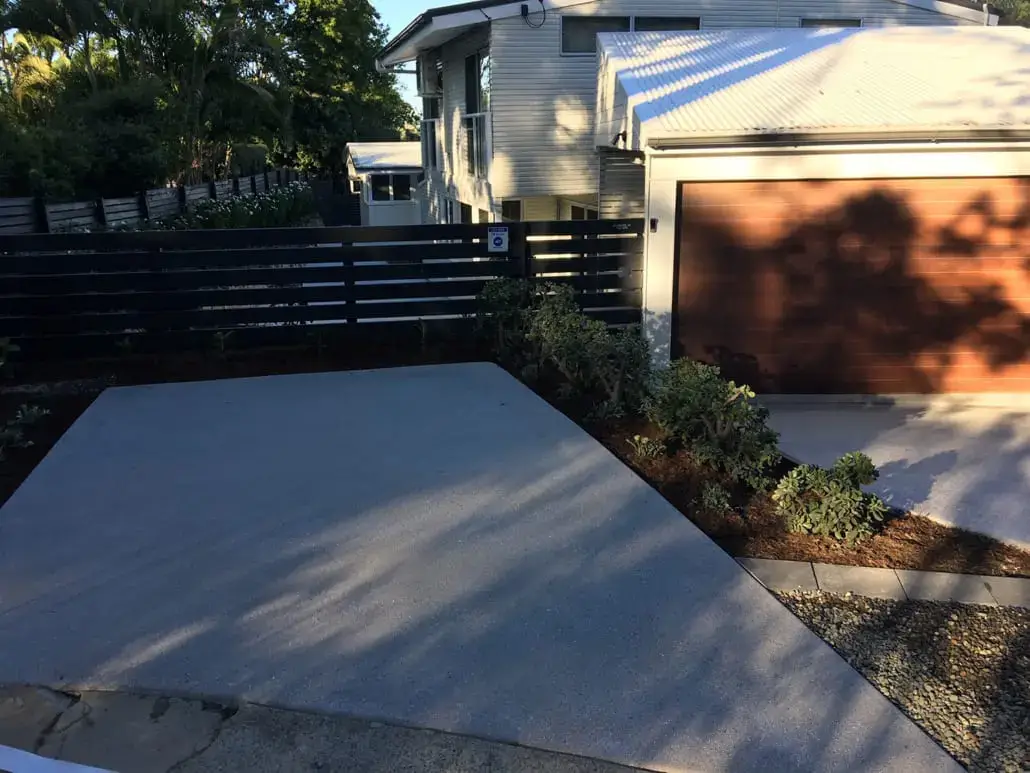
The South East Queensland default
Exposed aggregate — forgiving underfoot, and it hides the heat and the storms best.
Photographed on one of our own jobs in South East Queensland.
What the climate actually does
UV is the main antagonist. It breaks down sealers and, on cheap systems, fades pigment. Anything laid outdoors here needs a UV-stable sealer and oxide colour through the coating rather than a surface tint.
Then there is water. Summer storms deliver a lot of it very quickly, which finds every fall that runs the wrong way and every patch of slab that ponds. And in shaded, damp corners the by-product is organic growth, which is a slip issue before it is an appearance issue.
Slope decides more than looks
On any driveway with a real fall to the street — common across the western corridor and the hilly western suburbs — slip rating is the first specification, not the last. Exposed aggregate at R12 is the safest choice, with a textured sprayed finish at R11 next.
Smooth finishes and heavy gloss sealers on a slope are a genuine hazard when wet, and they are the most common thing we get called to correct after somebody chose on appearance alone.
The four realistic options
- Exposed aggregate. Best all-round performer: R12, hides dirt and tyre marks, wearing surface is stone. Thicker build-up, longer cure, higher cost.
- Stencilled finishes. Best value for a paved look over an existing slab. R10–R11 depending on texture, two colours, no joints for weeds. Pattern choice does the heavy lifting against brickwork.
- Coloured overlay with cuts. Strong colour depth, flagstone or crazy paving cut lines, forgiving to patch later. R11.
- Plain single colour. Quietest option, cheapest, easiest to blend when an extension happens. Choose the texture up rather than down if the drive slopes.
Colour choice and heat
Dark charcoals look excellent against render and hide oil, but they hold heat — noticeable if children or dogs cross the driveway barefoot in February. Mid-tone greys and warm sandstones sit cooler and show less dust than either extreme.
Against red or brown brick, terracotta and sandstone oxides read as paving. Against grey render and dark window frames, charcoal and mid grey read as architecture. Sampling on site against your own brick beats any colour chart.
What we would specify, unprompted
A flat suburban driveway in full sun, brick house: stencilled running bond or bushrock in two mid-tone oxides, two coats of UV-stable sealer.
A sloping driveway, any house: exposed aggregate, finer blend if it runs into a pool area, R12.
A rendered contemporary house: plain or lightly cut coloured overlay in mid grey or charcoal, texture chosen for the grade.
Short answers
Which driveway finish is the most slip resistant?
Exposed aggregate, at around R12. A textured sprayed or stencilled finish sits near R11.
Do dark driveways get too hot?
They get noticeably hotter than mid tones. It matters most on pool surrounds and anywhere people walk barefoot.
Will the colour fade in the Queensland sun?
Oxide colour through the coating is stable. Sealer dulls, and that is a re-coat, not a failure.
Written by the Decorative Concrete Resurfacing crew from work carried out across South East Queensland. Last reviewed . QBCC licence 1109935.
More in this cluster
Send a photo of the slab.
We will tell you whether it can be resurfaced, what finish suits it, and what it costs — before anyone turns up with a grinder.