Polished concrete has no overlay: the slab is ground through progressively finer diamond grits, densified and sealed, so the finished floor is the concrete itself. Cut depth sets the look — cream, salt-and-pepper or full stone. It needs a flat, sound, unpatched slab, which we establish with a test grind before recommending it.
Polished concrete in Brisbane and Ipswich
Mechanically ground through finer diamond grits to a honed or gloss sheen — the slab itself as the finished floor.
Polishing is subtractive: there is no overlay, no coating and no colour. We grind through progressively finer diamond grits until the surface reaches the level of sheen you want, then densify and seal it. What you see is the concrete, its sand and whatever stone the grind exposes.
How much stone appears depends on how deep the cut goes — a light cut keeps a cream, cement-rich surface, a deeper cut opens up salt-and-pepper sand, and deeper again brings out full aggregate. That decision is made on site off a test patch, because it depends on what your slab actually contains.
It suits interior floors, garages, studios and commercial spaces. Outside, honed rather than gloss, with a slip-rated sealer.
Polished concrete, by the numbers
Figures are for a standard residential job in South East Queensland conditions. Your quote states the build-up for your slab.
| Build-up | None — the slab is the finish |
|---|---|
| Foot traffic | 24 hours after sealing |
| Vehicles | 48–72 hours |
| Sheen | Honed matt, satin or gloss |
| Exposure | Cream, salt and pepper, or full stone |
| Slip rating | R10 interior, R11 with grip additive |
Where this finish belongs
These are the situations where we would put polished concrete forward without being asked for it.
- Interior floors on a flat, sound slab poured with polishing in mind
- Garages, studios and workshops where the slab itself should be the floor
- Commercial and retail spaces needing a hard-wearing, low-maintenance surface
- Extensions where a new slab can be finished for polishing from the pour
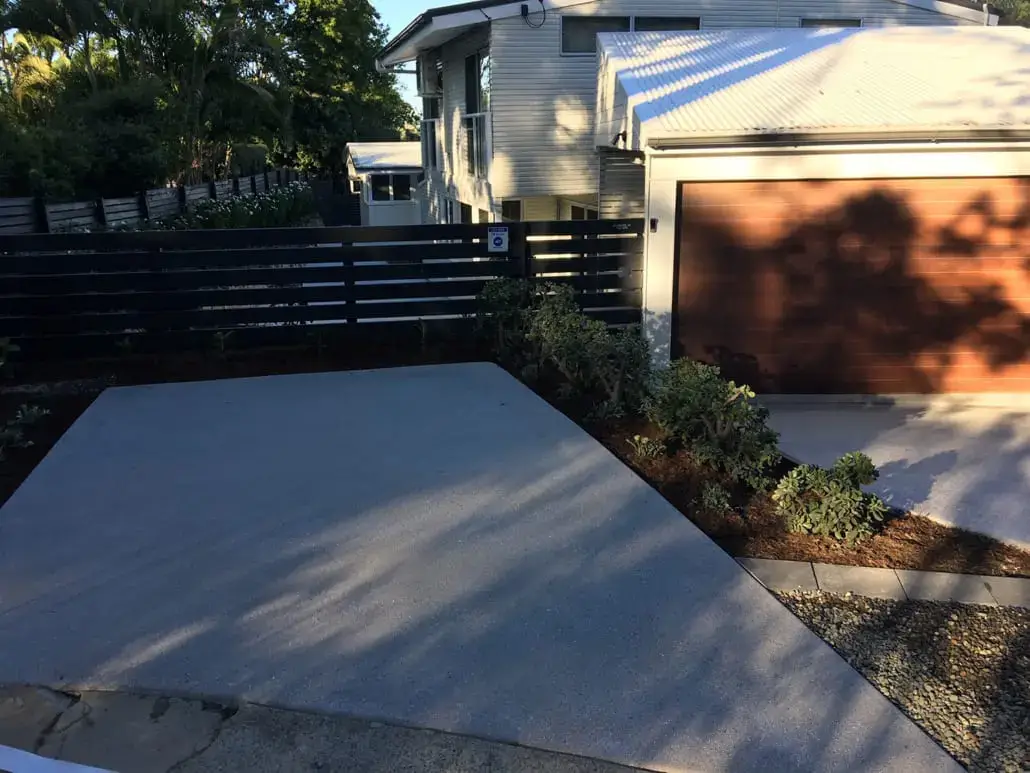
This is the actual finish.
Photographed on a job, sealed, in daylight. We bring samples to the quote so you can see it against your own brick and render.
Where we would not use it
Patched, painted or soft sandy slabs come up blotchy and cannot be corrected afterwards — those floors get an overlay instead.
If your job falls into that category we will say so at the quote and put up the finish that does suit it, rather than selling you the one you asked about.
Looking after it
Dust mop and damp mop with a pH-neutral cleaner. Avoid acidic and citrus cleaners, which etch. Interior polished floors need re-densifying or re-sealing far less often than exterior work, but high-traffic lines will burnish differently over time, which most people read as character.
Full detail, including re-seal intervals by exposure and safe cleaning pressures, is in the sealing and maintenance guide.
The questions we get asked
Can any slab be polished?
Only where the slab is flat, sound and deep enough to take the grind. Patched, painted or badly finished slabs often polish better after an overlay — we test first.
Is it the same as grind and seal?
Grind and seal is a lighter cut with a topical sealer; full mechanical polishing goes further and cures the surface itself. We quote both.
Can I see it before committing?
Yes. Samples come to the quote, and we can usually point you at a job in your suburb to drive past.
How often will it need re-sealing?
Every three to five years in full sun and around five to seven under cover. The sealer is the wearing layer and re-coating it is a fraction of the cost of a new finish.
Guides on this finish
Send a photo of the slab.
We will tell you whether it can be resurfaced, what finish suits it, and what it costs — before anyone turns up with a grinder.