Types of concrete cracks, and what each one means
Nathan Carter · Decorative Concrete Resurfacing · Updated 24 August 2026Shrinkage cracks are thin, straight and usually finished moving — routine to repair. Settlement cracks show a vertical step, meaning ground under the slab moved. Structural cracks are wide, full-depth and often multi-directional, and they rule resurfacing out. Crazing is cosmetic surface webbing; spalling is surface loss that grinds out.
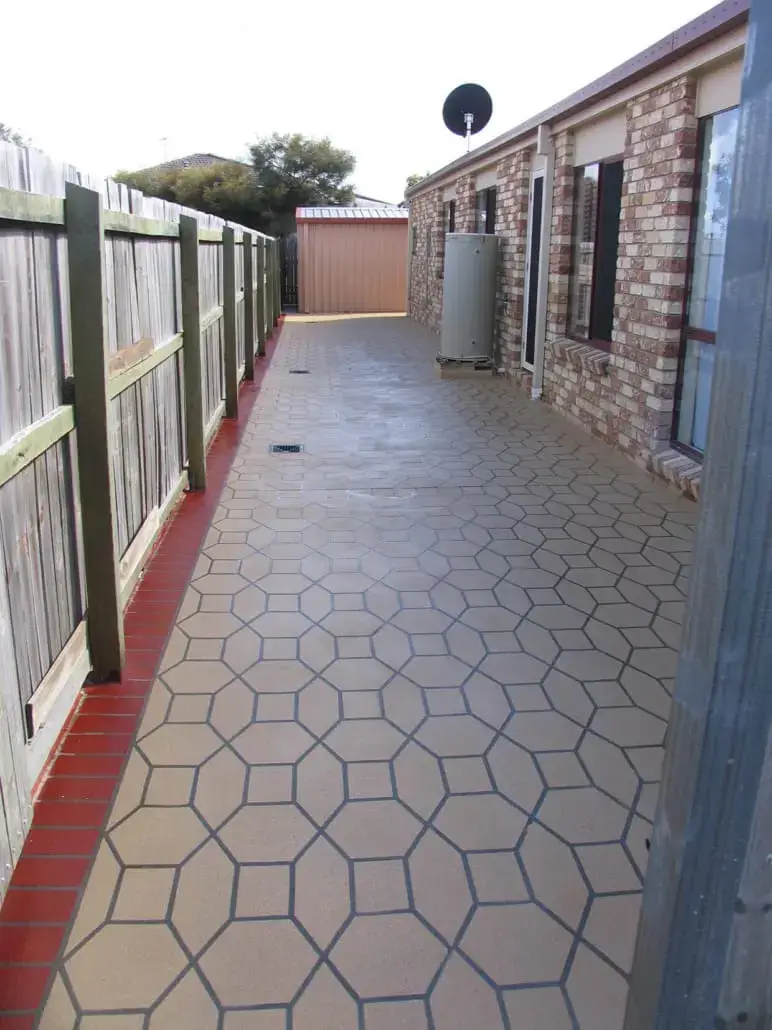
Where cracks show first
Side-of-house runs and narrow paths crack at the joints and edges before anywhere else.
Photographed on one of our own jobs in South East Queensland.
Shrinkage cracks
Concrete shrinks as it cures and keeps shrinking slowly for months. Where there is not enough control jointing, or where a slab has a re-entrant corner, that shrinkage relieves itself as a crack — usually thin, usually straight-ish, and usually finished moving within the first year or two.
These are the most common cracks on residential driveways and the most straightforward to deal with: cut, fill, bridge, overlay.
Settlement cracks
When the ground under part of the slab compacts or washes out, that section drops. The crack that results often has a vertical step: run your hand across it and one side is lower than the other. Settlement cracks frequently appear near driveway edges, at fill lines, and around trenches that were backfilled without compaction.
A stepped crack is a signal that something under the slab moved. Whether it is still moving decides everything, and that is what testing establishes.
Structural cracks
Wide, running through the full slab thickness, often in more than one direction, sometimes with rust staining where reinforcement is corroding. These come from overload, inadequate thickness, missing or misplaced reinforcement, or serious ground movement.
Structural cracks are the ones that rule out resurfacing. An overlay adds no capacity, so the fault persists and reappears. Replacement of the affected area — sometimes the slab — is the honest answer.
Crazing and spalling
Crazing is a fine web of hairline cracks across the surface, like a dry riverbed at small scale. It is caused by rapid surface drying and it is purely cosmetic. It disappears under an overlay with no special treatment.
Spalling is surface loss — flaking, pitting, sections lifting away. It usually means the top few millimetres were weak from over-troweling, too much water in the mix, or years of freeze-thaw and salt. Grinding removes the weak layer; the overlay replaces it. Where spalling has exposed steel, the steel is treated and the area rebuilt first.
A simple field test
Mark both sides of the crack with a pencil line and note the date. Measure across the marks with a ruler. Come back in a season — after a very wet spell and after a dry one. If the distance has not changed and there is no step, you are looking at a stable crack, and resurfacing is on the table.
That is a crude version of what we do at quote time, and it is genuinely useful if you are trying to decide whether to get anyone out at all.
Short answers
Is a hairline crack in my driveway serious?
Usually not. Thin, stable, un-stepped cracks are shrinkage cracks and are routine to repair before an overlay.
What does a stepped crack mean?
That one side has moved vertically — a settlement signal. It needs testing for ongoing movement before any surface work is quoted.
Should I fill cracks myself before you quote?
Please do not. A crack full of hardware-store filler has to be cut back out again, and it hides the information we need.
Written by the Decorative Concrete Resurfacing crew from work carried out across South East Queensland. Last reviewed . QBCC licence 1109935.
More in this cluster
Send a photo of the slab.
We will tell you whether it can be resurfaced, what finish suits it, and what it costs — before anyone turns up with a grinder.