Non-slip finishes for pool surrounds
Nathan Carter · Decorative Concrete Resurfacing · Updated 24 August 2026Specify R11 as a minimum and R12 where children run, and remember the rating applies to the sealed surface, so gloss sealers can undo a textured finish. Fine texture at high frequency grips without hurting bare feet: a fine aggregate blend washed back harder, or stamped relief with rounded edges. Failed coping is rebuilt before the surround is laid.
Grip leads on wet areas
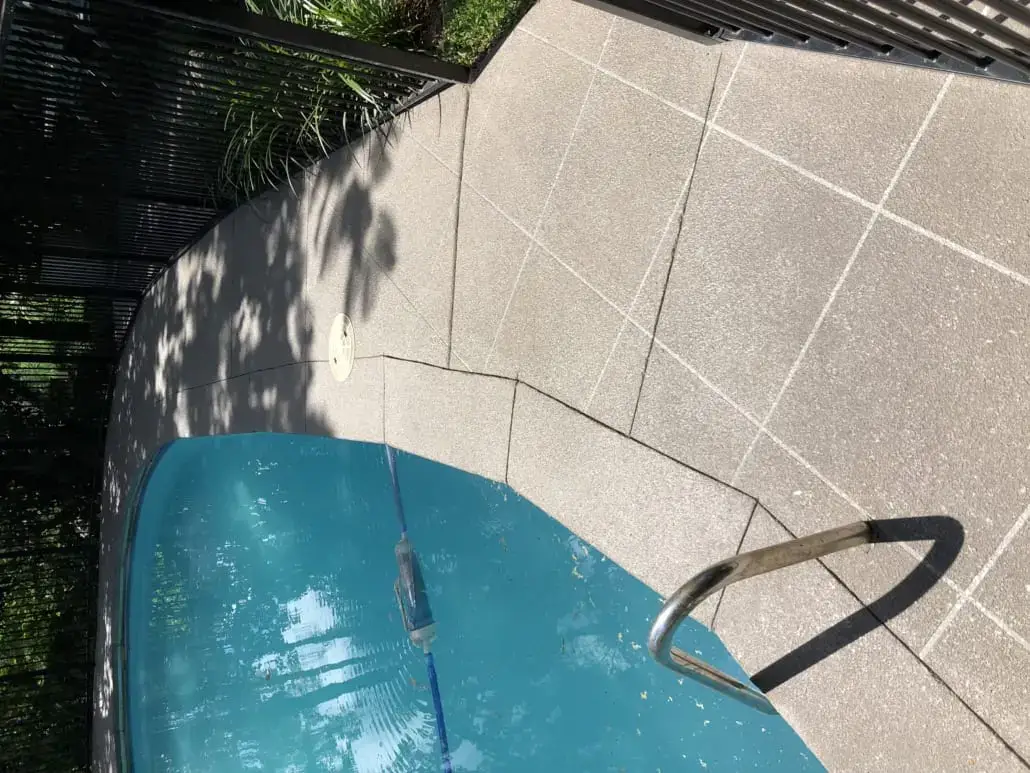
A speckled pool surround at R11 — texture chosen before colour.
Photographed on one of our own jobs in South East Queensland.
Slip ratings, briefly
The R-rating scale describes ramp-tested slip resistance. R10 is a smooth interior-appropriate surface. R11 is the practical minimum for an external area that gets wet. R12 is what you want on a pool surround, a sloping driveway or a ramp.
Ratings are a property of the finished, sealed surface — not the product in the tin. A gloss sealer over a textured finish can pull the effective rating down, which is why sealer choice belongs in the same conversation as finish choice.
Grip and comfort are different problems
Coarse aggregate is grippy and, on bare feet at a pool, unpleasant. The trick is fine texture at high frequency rather than coarse texture: a finer aggregate blend washed back harder, or a stamped texture with rounded relief, gives grip without abrasion.
Test it the way it will be used — barefoot, wet. Any sample that is uncomfortable dry will be worse after a summer of use.
What we specify around pools
- Exposed aggregate, fine blend. R12, washed back harder than a driveway spec, comfortable underfoot. Our default.
- Stamped with rounded relief. R11–R12, more decorative, texture you can feel without sharpness.
- Textured sprayed finish. R11, most economical, good where the surround is largely shaded.
- Timber look. R11, light tones only — dark plank colours get hot where people stand and wait.
Coping and edges
Most pool surround jobs include coping work. Spalled, drummy or lifting coping is both a trip and cut hazard and a water path into the shell beam, and it has to be cut back and rebuilt before the surround goes down.
The finished surface should run cleanly into the coping line with no lip. Where the existing coping is sound, we finish to it; where it has failed, we rebuild it and profile the edge so the transition disappears.
Chemicals, salt and shade
Splash-out from a chlorinated or salt pool is normal service, and the sealer takes it. What shortens sealer life is undiluted chemical sitting on the surface — dumping a bucket of concentrate on the surround, or letting salt crystallise and stay.
On the shaded southern side, organic growth is the main slip risk over time. Keep leaf litter off it, treat growth when it appears, and factor a slightly higher texture into the specification if that side is permanently damp.
Short answers
What slip rating should a pool surround be?
R11 as a minimum and R12 preferred. The rating applies to the sealed surface, so sealer choice matters as much as texture.
Is exposed aggregate too rough for bare feet?
Not with a finer blend and a harder wash-back, which is how we specify it around pools rather than on driveways.
Can you resurface right up to the water?
Up to and including the coping, once any failed coping has been repaired. The pool is masked and protected throughout.
Written by the Decorative Concrete Resurfacing crew from work carried out across South East Queensland. Last reviewed . QBCC licence 1109935.
More in this cluster
Send a photo of the slab.
We will tell you whether it can be resurfaced, what finish suits it, and what it costs — before anyone turns up with a grinder.