The concrete resurfacing process, step by step
Nathan Carter · Decorative Concrete Resurfacing · Updated 24 August 2026Concrete resurfacing runs in four stages: grind the slab back to sound concrete and test it for moisture and movement; repair cracks, rebuild edges and correct falls, then prime; lay the finish to the quoted build-up; seal with two coats of UV-stable sealer. Foot traffic at 24 hours, vehicles at 72 on most finishes.
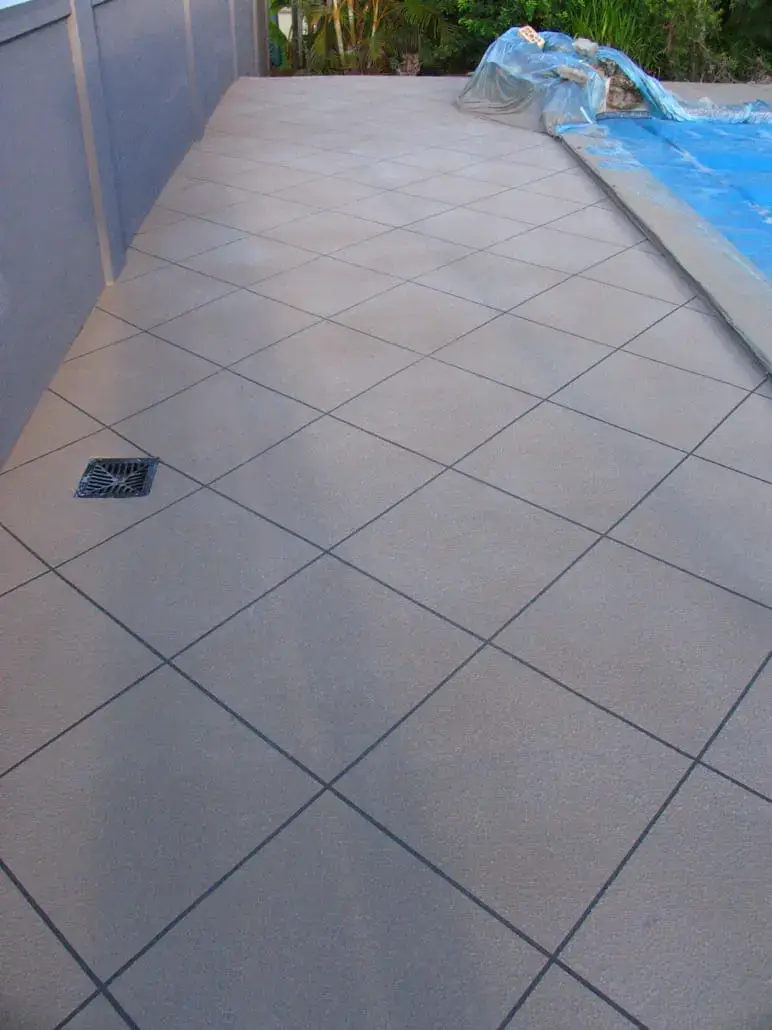
Four days, in the same order
Prepared, primed, laid and sealed — the finish is the last day of the job.
Photographed on one of our own jobs in South East Queensland.
Stage one — grind and test
The slab is diamond ground under vacuum extraction until it is clean, open concrete: no sealer, no laitance, no glue, no paint, no organic growth. This is what the overlay bonds to, and it is the only stage that cannot be corrected later.
While the machine is running we learn what the slab is. A test patch shows how the concrete grinds — hard and dense, or soft and sandy. Then it gets moisture tested, and any cracks get loaded and watched for movement. If the slab fails, this is where we stop and tell you, before you have paid for a finish.
Stage two — repair and prime
Cracks are cut out to a clean profile, vacuumed, filled with flexible repair mortar and bridged with a reinforcing membrane. Spalled edges and nosings are rebuilt. Perished expansion joints are cut out and replaced rather than coated over.
Falls get corrected here too. If water is running toward the house, the garage or the pool, that is fixed with the build-up while there is still material to play with. Then the whole area is primed — same day, because primer works on a clean slab, not one that has had a night to collect dust.
Stage three — lay the finish
This is the day people picture. Depending on the system: a sprayed cementitious coating through a hopper gun, a trowelled overlay, a wet-cast aggregate layer washed back once it takes its set, a stencil laid and lifted while the second colour is green, or texture mats pressed into a plastic overlay.
Layout happens before any material is mixed. Pattern lines, borders and cut lines are set out from the joints and the architecture, not from where the crew happened to start. Getting that wrong is permanent, so it is chalked, checked and agreed before anything is laid.
Stage four — seal and cure
Two coats of UV-stable sealer, applied once the finish has taken its initial cure. The sealer is what holds the colour, resists staining and takes the wear. It is also the part you will replace in a few years, which is normal and cheap.
Then the waiting: foot traffic at 24 hours, vehicles at 72 for most finishes. Exposed aggregate and stamped work want up to seven days before vehicles, because they are thicker and wet-cast. Driving on green concrete work is how edges break up in the first fortnight.
What weather does to the schedule
Overlays and sealers need a dry slab and a dry forecast. A wet week stops work — not out of caution but because water in the coating or under the sealer causes blushing, poor bond and colour variation that cannot be fixed afterwards.
In practice that means a two-day job can span a week in a wet February. We would rather tell you that up front than lay a finish into a forecast we do not believe.
Short answers
How long is my driveway out of action?
Two to three days on site for most residential driveways, then 72 hours before vehicles. Long driveways can be staged so you keep access to one side.
Do you need water and power?
Yes — a tap and a standard outlet. If neither is available we bring generation, which is worth mentioning at quote time.
How much mess is there?
Grinding runs under vacuum extraction, so far less than people expect. Wet cutting produces slurry, which is contained and washed off.
Written by the Decorative Concrete Resurfacing crew from work carried out across South East Queensland. Last reviewed . QBCC licence 1109935.
More in this cluster
Send a photo of the slab.
We will tell you whether it can be resurfaced, what finish suits it, and what it costs — before anyone turns up with a grinder.