Exposed aggregate is a 10 mm wet-cast layer containing selected stone, washed back after initial set so the aggregate stands proud. At about R12 it is the most slip-resistant finish we lay, which is why it is the South East Queensland default for driveways on a fall and for pool surrounds. Foot traffic at 72 hours, vehicles at seven days.
Exposed aggregate in Brisbane and Ipswich
Washed back to reveal the stone. The South East Queensland driveway default, and the most forgiving surface underfoot.
Exposed aggregate is a 10 mm wet-cast layer containing selected stone, washed back once it has taken its initial set so the aggregate sits proud of the cement. The result is a surface with real depth, strong grip, and a look that reads as stone rather than as concrete.
It is the most popular driveway finish in South East Queensland for good reason: it hides dirt, it does not show tyre marks the way a plain surface does, and at R12 it is the safest of our finishes on a slope or beside a pool.
Stone selection drives the whole look — river pebble for warm, rounded texture, crushed granite for a sharper contemporary grey, or a black basalt blend where the house is dark.
Exposed aggregate, by the numbers
Figures are for a standard residential job in South East Queensland conditions. Your quote states the build-up for your slab.
| Build-up | 10 mm |
|---|---|
| Foot traffic | 72 hours |
| Vehicles | 7 days |
| Slip rating | R12 |
| Aggregate | River pebble, granite, basalt blends |
| Sealer | Two coats, UV stable |
Where this finish belongs
These are the situations where we would put exposed aggregate forward without being asked for it.
- Driveways on a fall, where R12 slip resistance matters more than anything else
- Pool surrounds, with a finer blend and a harder wash-back
- Acreage and long driveways where a stone surface suits the setting
- Anywhere tyre marks and dirt need to disappear rather than be scrubbed
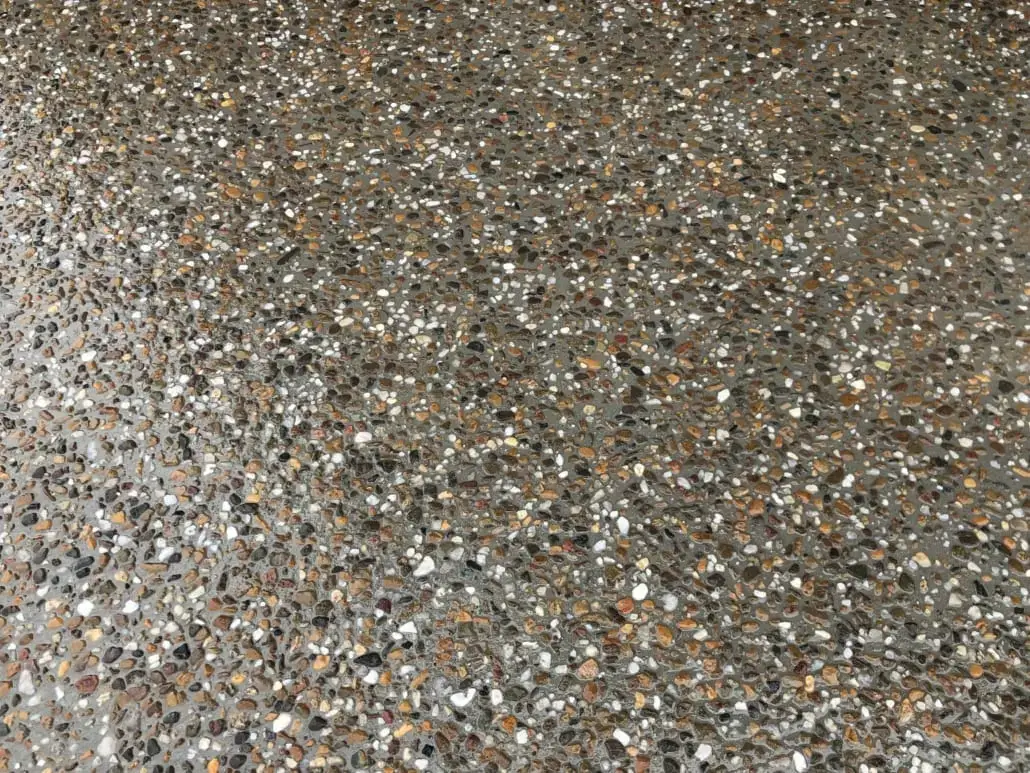
This is the actual finish.
Photographed on a job, sealed, in daylight. We bring samples to the quote so you can see it against your own brick and render.
Where we would not use it
Not the right finish where levels are tight — a 10 mm build-up has to be allowed for at thresholds, gates and door clearances.
If your job falls into that category we will say so at the quote and put up the finish that does suit it, rather than selling you the one you asked about.
Looking after it
The wearing surface is stone, so it wears longest of anything we lay. Sweep grit off it rather than letting it grind underfoot, and re-seal on the usual three to five year cycle to keep the stone reading dark and defined rather than dusty.
Full detail, including re-seal intervals by exposure and safe cleaning pressures, is in the sealing and maintenance guide.
The questions we get asked
Is it uncomfortable underfoot?
A washed-back overlay is textured but not sharp. Around pools we specify a finer blend and a heavier wash so it stays comfortable wet and bare-footed.
Why does it take longer to cure?
It is a thicker, wet-cast layer. Rushing vehicles onto it inside a week is how the edges break up.
Can I see it before committing?
Yes. Samples come to the quote, and we can usually point you at a job in your suburb to drive past.
How often will it need re-sealing?
Every three to five years in full sun and around five to seven under cover. The sealer is the wearing layer and re-coating it is a fraction of the cost of a new finish.
Guides on this finish
Send a photo of the slab.
We will tell you whether it can be resurfaced, what finish suits it, and what it costs — before anyone turns up with a grinder.