Polished, honed or grind and seal
Nathan Carter · Decorative Concrete Resurfacing · Updated 24 August 2026Grind and seal takes its sheen from a topical sealer over a coarse grind — fastest and cheapest. Honed concrete is a deeper mechanical grind stopped at matt or satin, and is the right answer for most homes and anything outdoors. Fully polished concrete is refined to a reflective finish with the shine in the densified concrete itself.
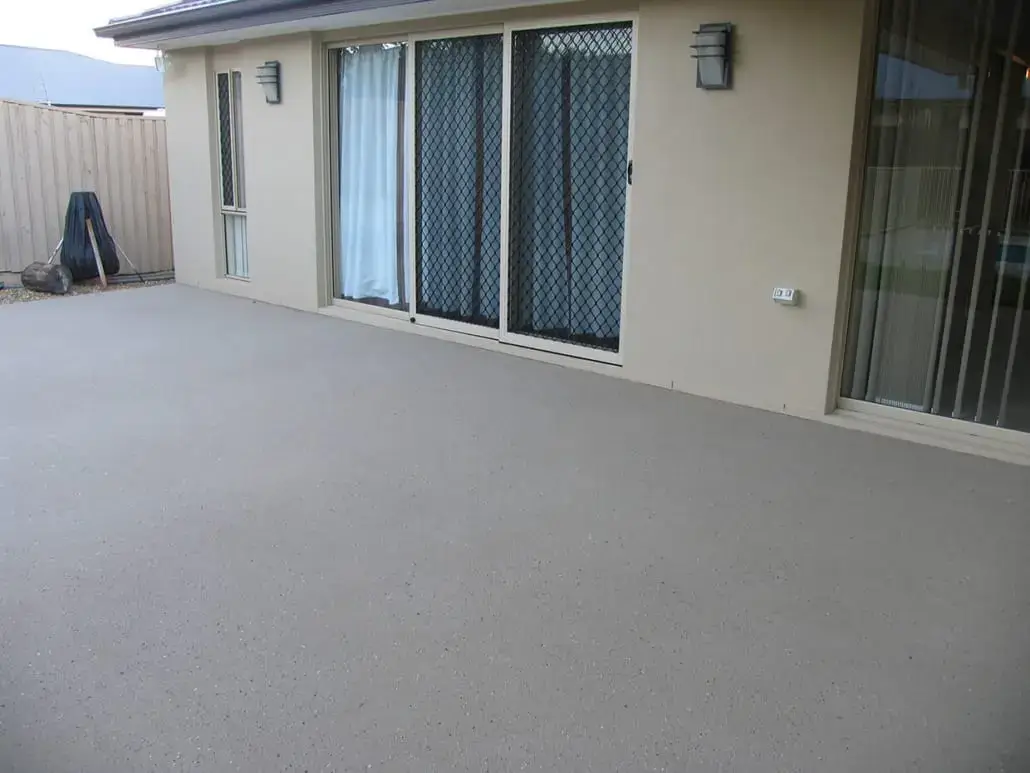
The slab itself as the finish
Ground through finer grits rather than coated — no build-up at all.
Photographed on one of our own jobs in South East Queensland.
Grind and seal
The slab is ground with coarse diamonds to flatten and open it, then a topical sealer goes over the surface. The sheen comes from the sealer, not the concrete.
It is the fastest and cheapest of the three, and it suits garages, workshops, laundries and budget-conscious interior floors. Because the finish lives in the sealer, it wears where traffic concentrates and gets re-coated periodically.
Honed concrete
A deeper mechanical grind through progressively finer diamond grits, stopping at a matt or satin level rather than continuing to gloss. The surface is then densified and sealed or impregnated.
Honed is the right answer for most residential floors and for anything external, because a matt surface keeps its slip resistance and does not show every scuff and swirl the way gloss does. It reads as stone rather than as a coated floor.
Fully polished concrete
The full progression through fine grits to a reflective finish, with a densifier hardening the surface so the shine comes from the concrete itself rather than a film on top of it.
It is the most expensive and the most demanding of the slab — flatness, hardness and the quality of the original finish all show. Beautiful in the right space; unforgiving in a slab that was never poured with it in mind.
Exposure level: the decision people forget
Independent of sheen, you choose how deep the cut goes, which decides what the floor looks like.
- Cream cut. Barely into the surface. Cement-rich, minimal stone. Quietest look.
- Salt and pepper. Into the sand and small aggregate. The most common residential choice.
- Full stone. Deep enough to expose the coarse aggregate. Dramatic, and entirely dependent on what your slab actually contains.
Which slabs are candidates
Flat, sound, reasonably hard slabs with no major patching and no adhesive-scarred history. Slabs with old tile beds, heavy patch repairs or soft, sandy surfaces polish badly — the differences telegraph as blotches and there is no fixing it afterwards.
On those floors an overlay is the better answer: a cementitious topping or a resin system gives an even surface to work with. We test-grind a patch before recommending polishing on any existing slab, because the slab decides this, not the brochure.
Short answers
Is grind and seal the same as polished concrete?
No. Grind and seal gets its sheen from a surface sealer; polished concrete is mechanically refined and densified so the shine is in the concrete.
Which is best outdoors?
Honed, with a slip-rated sealer. Gloss finishes outside are a slip risk when wet.
Can any slab be polished?
Only flat, sound, hard slabs without heavy patching. We test-grind first — patched or soft slabs come up blotchy and it cannot be corrected later.
Written by the Decorative Concrete Resurfacing crew from work carried out across South East Queensland. Last reviewed . QBCC licence 1109935.
Related pages
More in this cluster
Send a photo of the slab.
We will tell you whether it can be resurfaced, what finish suits it, and what it costs — before anyone turns up with a grinder.