Coloured concrete resurfacing carries full-strength oxide colour through a 3–4 mm overlay, usually with a flagstone, crazy-paving or ashlar pattern cut into it. Foot traffic at 24 hours, vehicles at 72, around R11. Because colour is mixed through the coating rather than painted on, wear exposes more of the same colour instead of grey concrete.
Coloured concrete in Brisbane and Ipswich
Full-strength oxide colour, with or without a cut pattern. Reads terracotta against brick and charcoal against render.
Colour is mixed through the overlay rather than painted on, so wear exposes more of the same colour instead of grey concrete. The palette runs from sandstone and terracotta through to charcoal, and the depth of colour holds up in Queensland sun because the sealer above it is UV stable.
Most coloured jobs take a cut pattern — crazy paving, flagstone or a simple ashlar grid — because the cut lines break up a large field and hide the join where a day's work stops.
A second colour in the cuts, or a border in a contrasting oxide, is where a coloured driveway stops looking like a coating and starts looking like paving.
Coloured concrete, by the numbers
Figures are for a standard residential job in South East Queensland conditions. Your quote states the build-up for your slab.
| Build-up | 3–4 mm |
|---|---|
| Foot traffic | 24 hours |
| Vehicles | 72 hours |
| Slip rating | R11 |
| Colour | Full oxide range, custom match |
| Pattern | Plain, flagstone, crazy paving, ashlar |
Where this finish belongs
These are the situations where we would put coloured concrete forward without being asked for it.
- Brick houses, where terracotta and sandstone oxides read as paving
- Driveways that need a cut pattern to break up a large field
- Areas where a second colour in the cuts or a border is wanted
- Jobs where the colour has to be matched to existing brick or render
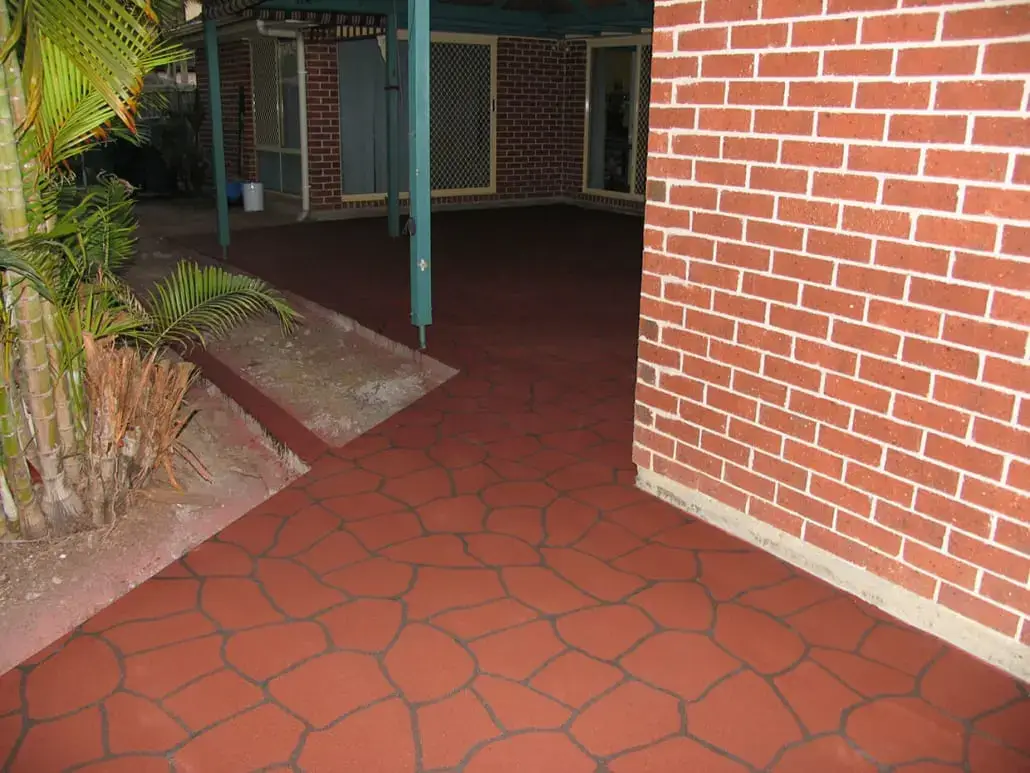
This is the actual finish.
Photographed on a job, sealed, in daylight. We bring samples to the quote so you can see it against your own brick and render.
Where we would not use it
Very dark colours hold heat, so we steer away from them on pool surrounds and anywhere people walk barefoot in summer.
If your job falls into that category we will say so at the quote and put up the finish that does suit it, rather than selling you the one you asked about.
Looking after it
Colour is mixed through the coating, so wear exposes more of the same colour rather than grey concrete underneath. Keep the sealer current and the colour keeps reading as laid; let the sealer go and the surface will look chalky long before it is actually worn.
Full detail, including re-seal intervals by exposure and safe cleaning pressures, is in the sealing and maintenance guide.
The questions we get asked
Does the colour fade?
Oxide colour is stable; sealer is the wearing layer. Re-sealing every few years keeps the colour looking as laid.
Can you match existing brickwork?
Usually close. We sample on site against the brick before the job is booked.
Can I see it before committing?
Yes. Samples come to the quote, and we can usually point you at a job in your suburb to drive past.
How often will it need re-sealing?
Every three to five years in full sun and around five to seven under cover. The sealer is the wearing layer and re-coating it is a fraction of the cost of a new finish.
Guides on this finish
Send a photo of the slab.
We will tell you whether it can be resurfaced, what finish suits it, and what it costs — before anyone turns up with a grinder.