Pre-quote checklist: what to check before anyone quotes your slab
Nathan Carter · Decorative Concrete Resurfacing · Updated 24 August 2026Before quoting, check five things yourself: whether the slab rocks under load, whether any crack has a vertical step, whether water ponds anywhere, what coating is already on the surface, and whether levels at thresholds and drains allow a build-up. Then measure the area and photograph the edges. Every quote you receive should state preparation, build-up in millimetres, sealer and cure times separately.
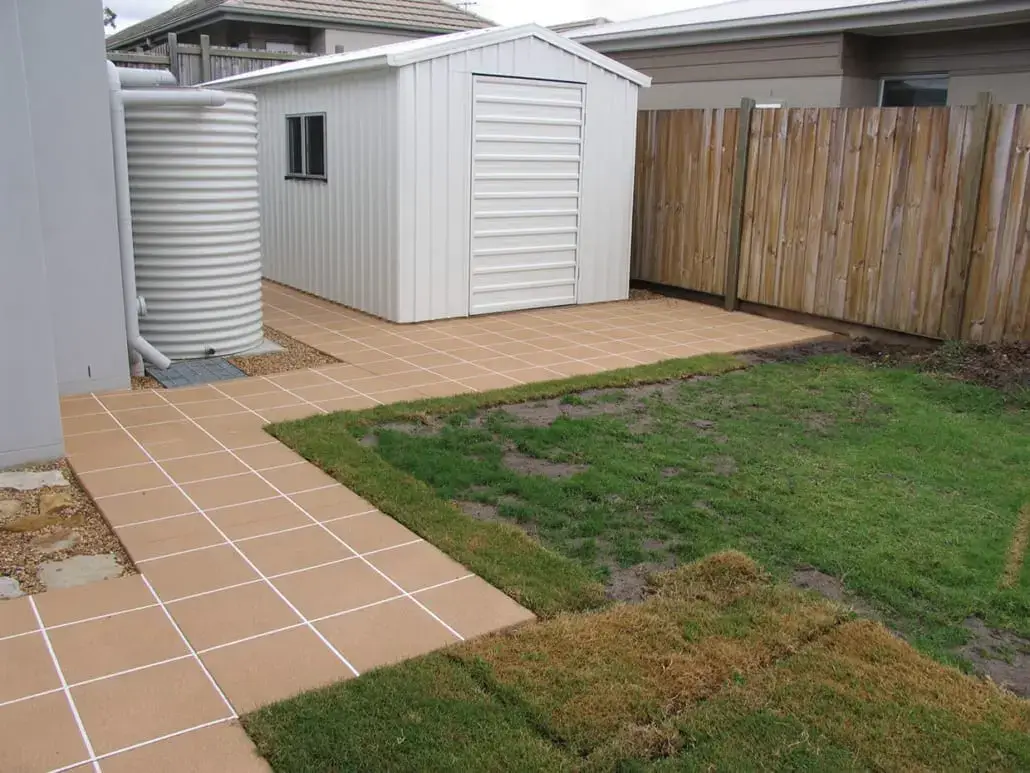
Check the whole run, not the entry
Shed slabs and connecting paths are where quotes most often miss area.
Photographed on one of our own jobs in South East Queensland.
Check the slab yourself first
- Movement. Drive a wheel slowly onto each section and watch the cracks. Any that open, close or step are live, and no overlay holds across them.
- Step. Run your hand across every crack. A vertical lip means one side has settled — a ground problem, not a surface problem.
- Ponding. Hose the slab and watch where water sits for more than a minute. Those spots need the fall corrected as part of the job.
- Damp. Tape a square of plastic sheet down overnight. Condensation underneath in the morning suggests moisture coming through, which changes the specification.
- Existing coating. Scratch an inconspicuous corner. Paint, sealer, tile glue or a previous overlay all have to come off first, and that is labour somebody has to price.
- Levels. Measure the gap under the garage door, at door sills, at drainage grates and at the pool coping. That gap is your build-up budget.
Measure it properly
Break the area into rectangles, measure each in metres, multiply and add. Note the awkward parts separately — steps, curved edges, narrow side runs — because those cost more per square metre than open areas and quotes vary most there.
Write down the total, the number of steps, the number of separate areas, and whether a truck can park within thirty metres of the work. Those four facts let any contractor give you a realistic preliminary range over the phone.
Photograph these five things
- A wide shot of the whole area from standing height, showing the shape and the fall
- The worst section close up — crack, spall, patch or stain
- Every edge: garage threshold, coping, kerb, garden, drainage grate
- Anything already on the slab, at an angle that shows the surface texture
- A tape measure or shoe in one frame for scale
What every quote should state in writing
- Preparation and finish itemised separately, not as one number
- Grinding method and what is being removed
- Crack and joint repair scope
- Fall correction, if any
- The system name and the build-up in millimetres
- Sealer product and number of coats
- Cure times for foot traffic and for vehicles
- Licence number and insurance status — in Queensland, check the licence on the QBCC register
- What happens if the slab fails testing once grinding starts, including whether the deposit is refundable
Questions worth asking out loud
Ask what happens on day one. Ask whether the slab will be moisture tested. Ask who lays the decorative finish — the same crew, or a subcontractor. Ask what they would do if they found a live crack halfway through.
You are not testing their product knowledge. You are finding out whether preparation is where their time goes, because that is what decides whether the surface is still there in ten years.
Short answers
How many quotes should I get?
Three is sensible, and compare the preparation lines rather than the totals. A cheaper quote with no grind or no second sealer coat is not cheaper, it is smaller.
Should I clean the slab before the quote?
Sweep it, but do not pressure clean or fill anything. We need to see what is actually on the surface and how the cracks behave.
What if two quotes disagree about whether it can be resurfaced?
Ask each to show you the test — the ground patch, the moisture reading, the crack under load. The one who can show you the evidence is the one to believe.
Written by the Decorative Concrete Resurfacing crew from work carried out across South East Queensland. Last reviewed . QBCC licence 1109935.
Send a photo of the slab.
We will tell you whether it can be resurfaced, what finish suits it, and what it costs — before anyone turns up with a grinder.