Concrete resurfacing glossary
Nathan Carter · Decorative Concrete Resurfacing · Updated 24 August 2026Concrete resurfacing has its own vocabulary, and most of it appears on quotes without explanation. This glossary defines 26 terms used in Australian decorative concrete work — overlay, build-up, laitance, delamination, live crack, crack bridging, slip rating, honed, polished, grind and seal, sacrificial sealer — as they are used on site, not as marketing language.
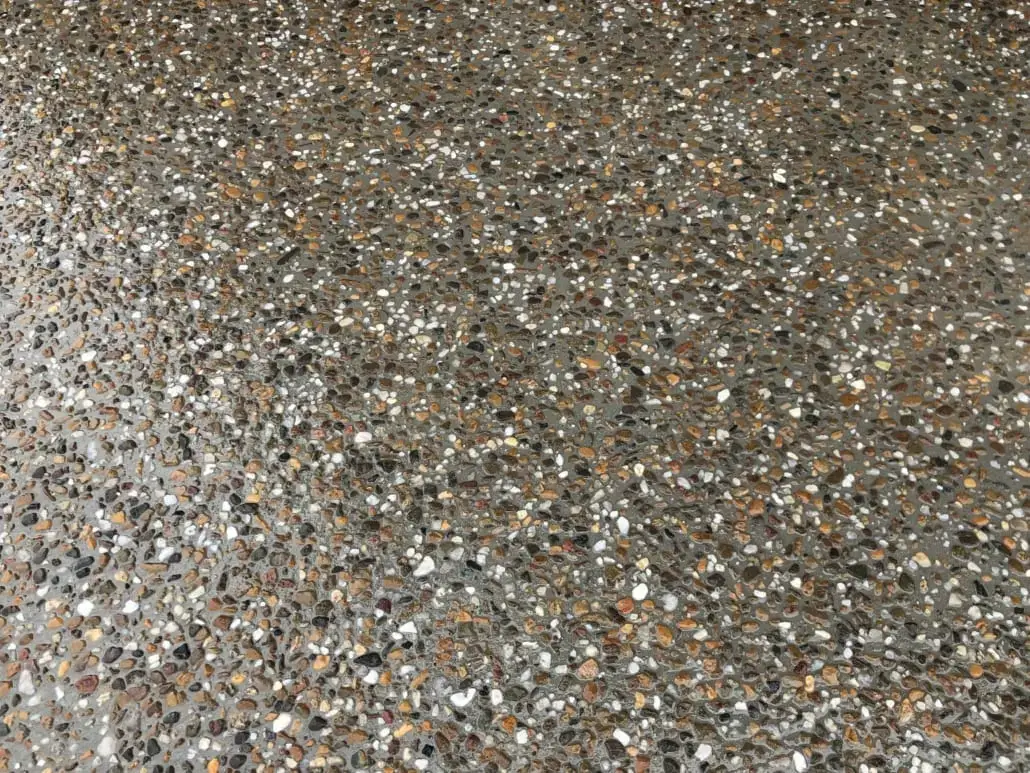
Aggregate, build-up, exposure
Terms from data sheets, as they apply to real finishes.
Photographed on one of our own jobs in South East Queensland.
Concrete resurfacing terms defined
Twenty-six terms that appear on quotes, specifications and product data sheets, defined the way we use them on site.
- Overlay
- A cementitious or resin layer bonded to an existing slab, typically 2–10 mm thick, that becomes the new wearing surface. It replaces the surface, not the slab, and adds no structural capacity.
- Build-up
- The finished thickness of an overlay in millimetres. It matters because thresholds, gates, drainage and door clearances all have to accommodate it — 3 mm sprayed work is invisible at an edge, 10 mm aggregate is not.
- Laitance
- The weak, cement-rich film left on the surface of a slab by finishing and curing. Overlays bonded to laitance rather than through it are the most common cause of delamination.
- Delamination
- Loss of bond between an overlay and the slab, so the coating lifts in sheets or patches. Almost always a preparation failure: sealed, dirty or damp concrete underneath.
- Diamond grinding
- Mechanical removal of the surface with diamond-segment tooling, under vacuum extraction, to expose clean, open concrete with a profile an overlay can key into.
- Moisture test
- A measurement of moisture in or rising through a slab before coating. Overlays and resins applied over damp concrete are pushed off from underneath, so the test decides whether the job proceeds.
- Shrinkage crack
- A crack formed as concrete cured and shrank, usually thin, straight and stable. Repairable and overlayable once cut, filled and bridged.
- Settlement crack
- A crack with a vertical step, caused by ground under one side of the slab compacting or washing out. Needs testing for ongoing movement before any surface work.
- Live crack
- A crack still opening, closing or stepping with seasonal moisture and load. No surface treatment holds across a live crack.
- Crazing
- A fine web of hairline surface cracks caused by rapid surface drying. Cosmetic only; it disappears under an overlay with no special treatment.
- Spalling
- Loss of the surface in flakes or patches, usually from a weak, over-trowelled or high-water-content top layer. Ground off and replaced by the overlay; exposed steel is treated first.
- Crack bridging membrane
- A reinforcing fabric or membrane bedded over a repaired crack so residual movement is spread across a wider band instead of concentrating in one line.
- Control joint
- A saw-cut or formed joint that tells a slab where to crack. Positioned to the slab, not to the eye, and set out with the decorative pattern so joints do not cut across a pattern at random.
- Expansion joint
- A full-depth joint filled with compressible material that lets adjoining slabs move independently. Perished joints are cut out and replaced rather than coated over.
- Slip rating (R value)
- A ramp-tested measure of slip resistance. R10 is smooth and interior-appropriate, R11 is the practical minimum for wet external areas, R12 is specified for pool surrounds and sloping driveways. It applies to the sealed surface, not the product in the tin.
- Exposed aggregate
- A wet-cast layer containing selected stone, washed back after initial set so the aggregate stands proud of the cement. Around 10 mm, about R12, with stone as the wearing surface.
- Stencilled concrete
- A pattern created by laying a single-use paper stencil over a base colour, spraying a second colour, and lifting the stencil while the coating is green — leaving joint lines in the base colour.
- Stamped concrete
- Texture pressed into a plastic overlay with mats, then colour-washed so low points hold darker colour. Physical relief rather than printed pattern, so slip performance holds when wet.
- Covercrete / Covacrete
- Trade names for polymer-modified cementitious coatings sprayed through a hopper gun to a fine speckle, around 3–4 mm. A category of spray-applied overlay rather than a single product.
- Grind and seal
- A coarse mechanical grind followed by a topical sealer. The sheen comes from the sealer, so the finish wears where traffic concentrates and is re-coated periodically.
- Honed concrete
- A deeper mechanical grind through finer diamond grits, stopped at a matt or satin level, then densified and sealed. The right choice for most homes and for anything external.
- Polished concrete
- Mechanical refinement through fine grits with a densifier, so the shine is in the concrete itself rather than in a film on top of it. Requires a flat, sound, unpatched slab.
- Vinyl flake system
- A resin floor built as a pigmented basecoat, coloured vinyl flake broadcast to refusal, and two clear topcoats — around 1–1.5 mm, with inherent texture and grip.
- Hot tyre pickup
- Coating lifting with a warm tyre. Not a property of epoxy as such, but of thin, poorly bonded epoxy over unground concrete.
- Sacrificial sealer
- A sealer intended to wear and be replaced — typically every three to five years in full sun — rather than to last the life of the finish beneath it.
- QBCC licence
- A licence issued by the Queensland Building and Construction Commission, required for building and concreting work above the statutory threshold. Ours is 1109935 and can be checked on the public register.
Written by the Decorative Concrete Resurfacing crew from work carried out across South East Queensland. Last reviewed . QBCC licence 1109935.
Where these terms are used
Send a photo of the slab.
We will tell you whether it can be resurfaced, what finish suits it, and what it costs — before anyone turns up with a grinder.