Concrete resurfacing or pavers?
Nathan Carter · Decorative Concrete Resurfacing · Updated 24 August 2026Over a sound existing slab, resurfacing is faster, thinner and has no joints for weeds or ants; pavers add 40–60 mm of height, need edge restraint and jointing sand, and can be lifted individually for repair. Resurfacing keeps levels at thresholds and drains; pavers suit areas where the slab has to be raised or partly relaid.
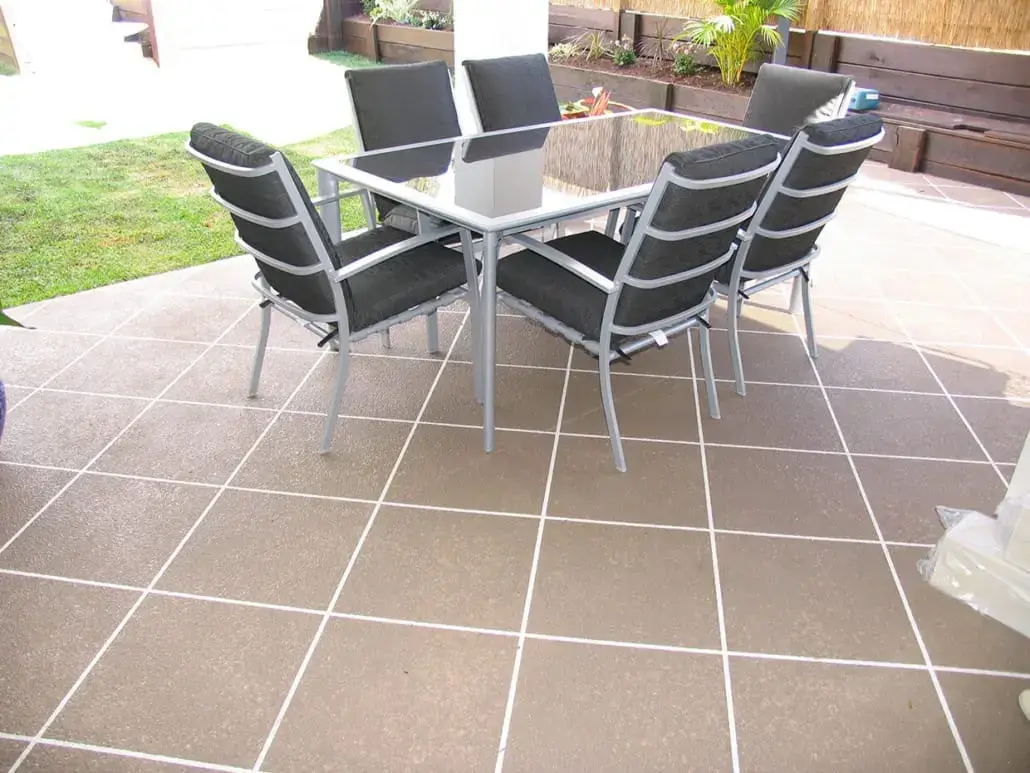
A pattern without the joints
Diamond tile in an overlay: the look of pavers with nothing to lift or weed.
Photographed on one of our own jobs in South East Queensland.
The height problem decides most jobs
A paver over an existing slab adds the paver thickness plus its bedding — commonly 40–60 mm all up. That has to go somewhere. Against a garage threshold, a door sill, a pool coping or a drain grate, there is usually nowhere for it to go without cutting, ramping or re-setting the drainage.
An overlay adds 2–10 mm. On most residential jobs that is the whole argument: the levels stay where the builder set them, the door still clears, the grate still drains, and the transition to the kerb stays flush.
What each one does over time
- Joints. Pavers have thousands of them. That is where weeds germinate and where ants excavate the bedding sand, which is why paved driveways develop soft, dipping patches. A stencilled or coloured overlay has joint *lines*, not joint *gaps* — nothing to grow in, nothing to wash out.
- Movement. Pavers tolerate slab movement better, because individual units can settle without cracking. An overlay is bonded, so it follows the slab: fine on a stable slab, a problem on a moving one.
- Repair. A damaged paver can be lifted and swapped. A damaged overlay is patched or the area is re-coated, and a patch on a weathered surface will always read slightly differently.
- Cleaning. Overlays hose off as one continuous surface. Pavers need joint maintenance, re-sanding and occasional re-levelling.
- Slip. Both can be specified for grip. Washed aggregate at about R12 outperforms most smooth-faced pavers when wet.
Cost and time, honestly
Materially, pavers cost more per square metre installed than a sprayed or stencilled overlay, and less than a hand-finished stamped or timber-look overlay. Labour is the bigger difference: a paved driveway is a screeding, laying, cutting and compacting job measured in a week, where a resurfacing job over a sound slab is two to three days.
If the existing slab has to be removed to lay pavers properly, add demolition and disposal to the paver figure — and at that point the comparison is no longer resurfacing versus pavers, it is resurfacing versus a full rebuild.
When we would recommend pavers instead
When the slab is moving and cannot be economically replaced — pavers ride movement that would crack an overlay. When the finished level genuinely needs to come up, for drainage or to meet a new step. When the area will be dug up again for services within a few years, because pavers can be lifted and relaid. And when the client wants a specific stone or clay unit that no overlay honestly imitates.
We do not lay pavers. Saying so is the point: this comparison is not written to move you toward what we sell, and if pavers are the right answer for your slab you should hear that before you spend anything.
A quick way to decide
Look at the edges of your slab. If the garage threshold, drainage grates and coping are already tight to the existing surface, resurfacing is almost certainly the answer, because raising the level creates three new problems to solve.
Then load the slab and watch it. If it rocks or a crack moves, you have a movement problem, and pavers — or replacement — deserve serious consideration. If it is stable, an overlay will hold, cost less and be finished in days.
Short answers
Can pavers be laid straight over concrete?
Yes, on a bedding layer with proper edge restraint and drainage, but the finished level rises 40–60 mm, which is what rules it out at most thresholds.
Do resurfaced driveways get weeds?
No. There are no joint gaps to germinate in — the pattern joints on stencil work are a colour change in the coating, not a physical gap.
Which lasts longer?
On a stable slab, a properly prepared overlay with maintained sealer competes with pavers and needs less intervention. On a moving slab, pavers last longer because they can move with it.
Written by the Decorative Concrete Resurfacing crew from work carried out across South East Queensland. Last reviewed . QBCC licence 1109935.
Send a photo of the slab.
We will tell you whether it can be resurfaced, what finish suits it, and what it costs — before anyone turns up with a grinder.