Concrete sealer types compared
Nathan Carter · Decorative Concrete Resurfacing · Updated 24 August 2026Solvent-based acrylics wet colour out most and re-coat easily; water-based acrylics are lower odour and hold UV slightly better; polyurethanes are the most abrasion and chemical resistant but harder to re-coat; penetrating sealers change appearance least and leave slip resistance untouched. Outdoors in South East Queensland we specify two coats of a UV-stable system and re-coat every three to five years.
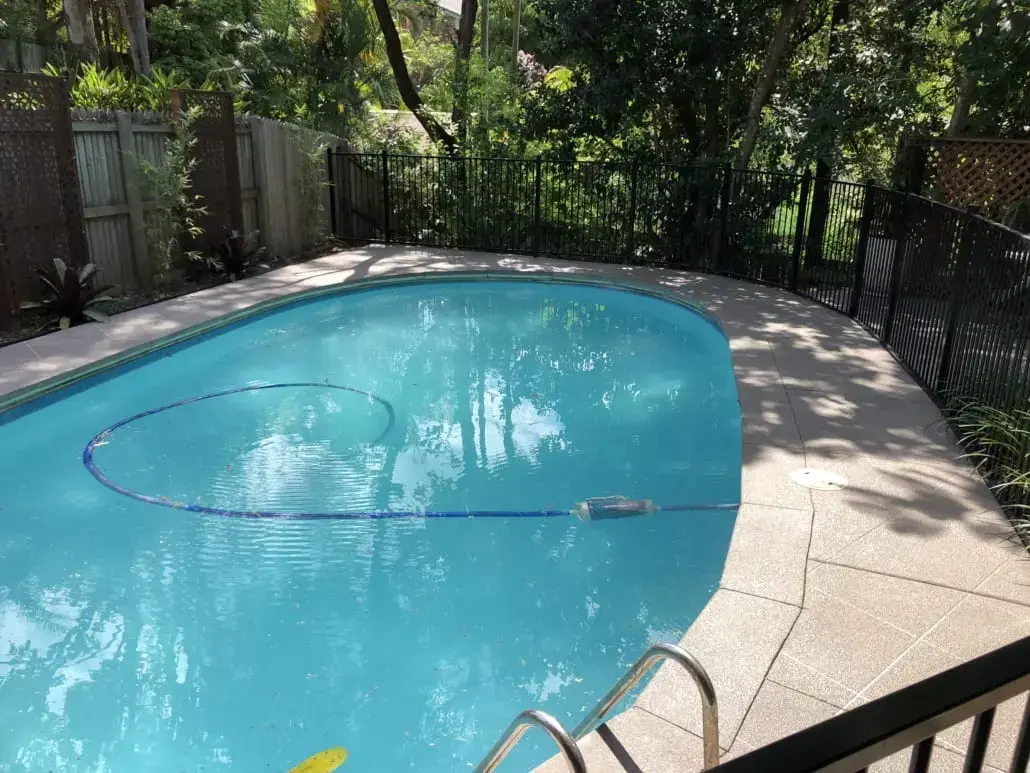
Sealer choice changes the look
The same coating reads differently under a penetrating sealer and a film-forming one.
Photographed on one of our own jobs in South East Queensland.
What a sealer is being asked to do
Four jobs at once: keep water and stains out of the coating, hold the colour against UV, take the mechanical wear that would otherwise hit the finish, and deliver the sheen you asked for. No single chemistry is best at all four, which is why there is a choice at all.
It is also the sacrificial layer. Every sealer is meant to be replaced — the question is how often, how easily, and what the surface looks like in the meantime.
The four families
| Finish | Foot traffic | Vehicles |
|---|---|---|
| Solvent-based acrylic | Deep colour, gloss | Easy — bites into itself |
| Water-based acrylic | Satin, less colour lift | Easy, low odour |
| Polyurethane | Hard, chemical resistant | Harder — needs abrasion |
| Penetrating (silane/siloxane) | Near-invisible, no sheen | Simple re-application |
Choosing by area, not by brochure
- Driveway in full sun: UV-stable acrylic, two coats, satin rather than high gloss. Gloss shows tyre marks and turns slick when wet.
- Pool surround: whatever holds the slip rating. A gloss film over a textured finish can pull an R12 surface back toward R11, so we favour satin acrylic or a penetrating sealer with a grip additive.
- Covered patio: solvent acrylic if you want the colour to sing, because UV load is low and the depth of colour is the whole point.
- Garage floor: polyurethane topcoat over epoxy or flake — it is the abrasion and chemical resistance you are paying for.
- Exposed aggregate you want to look natural: penetrating sealer. It protects without the wet look, though it will not deepen the stone the way a film does.
The mistakes that cost money
Sealing damp concrete, which traps moisture and blushes the film white. Sealing over dirt, which locks it in permanently. One thin coat instead of two, which halves the service life for a quarter of the saving. And mixing incompatible chemistries — a water-based product over a solvent film that has not been abraded will peel in sheets.
Keep a note of what went on your slab and when. It turns the next re-seal into a straightforward job rather than a grinding exercise.
Re-coat intervals we actually use
Full-sun driveway: three to five years. Shaded or covered patio: five to seven. Pool surround: three to five, splash-out deciding. Garage topcoat: on wear pattern rather than schedule, often longer than exterior work.
The signal is simple: when water stops beading and starts darkening the surface, the sealer is done. Re-coating at that point is cheap. Waiting until the finish itself is wearing is not.
Short answers
Can I seal a resurfaced driveway myself?
Yes, if the surface is clean and dry and the product is compatible with what is already there. Those two conditions are where DIY re-seals usually fail.
Does sealer make concrete slippery?
A high-gloss film can, especially over a smooth finish. Satin and penetrating sealers, or a grip additive, keep the slip rating where it was specified.
How many coats?
Two outdoors, always. One coat is a saving you pay back early.
Written by the Decorative Concrete Resurfacing crew from work carried out across South East Queensland. Last reviewed . QBCC licence 1109935.
More in this cluster
Send a photo of the slab.
We will tell you whether it can be resurfaced, what finish suits it, and what it costs — before anyone turns up with a grinder.