Concrete coating or sealer — what is the difference?
Nathan Carter · Decorative Concrete Resurfacing · Updated 24 August 2026A coating is a material laid on top of the slab to change it — thickness, colour, texture and wear resistance. A sealer is a thin protective layer over whatever is already there. Coatings replace a surface and cost accordingly; sealers protect one and cost far less. If your concrete looks dull but is intact, you need a sealer. If the surface itself has failed, you need a coating.
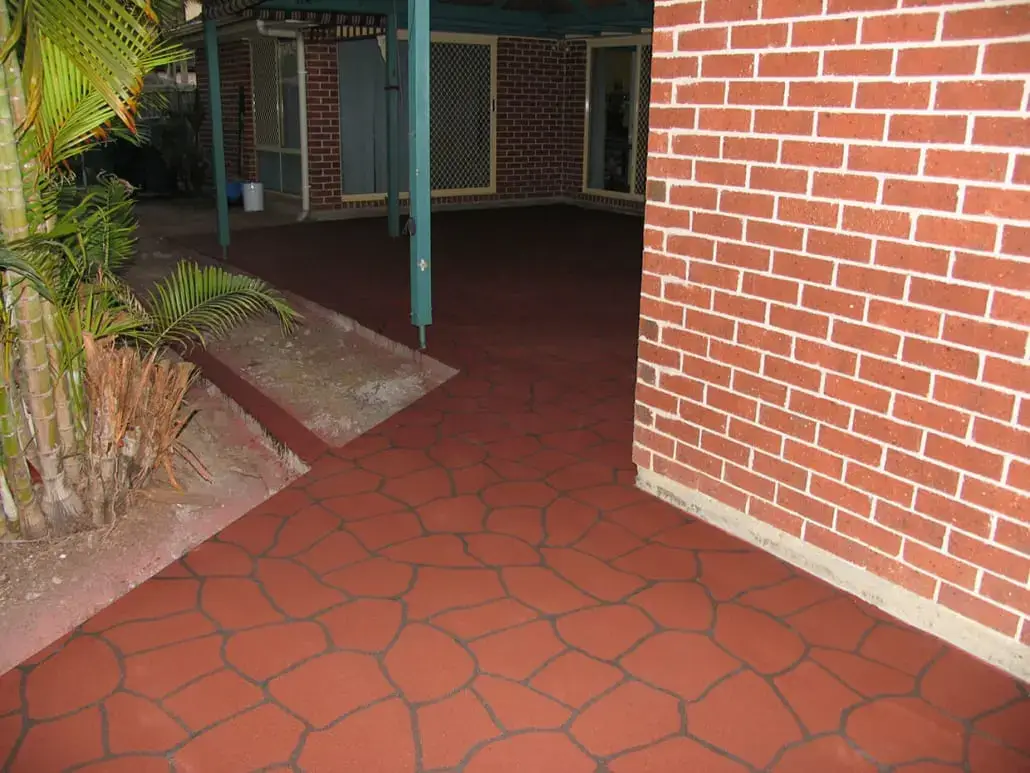
A coating has thickness; a sealer does not
Full-strength oxide in a cementitious coating, sealed on top.
Photographed on one of our own jobs in South East Queensland.
The short answer
The two words get used interchangeably by people selling both, which is where most of the confusion comes from. They are different products doing different jobs.
A coating adds material. Epoxy, vinyl flake, polyurethane and cement-based overlays all build thickness — anywhere from a fraction of a millimetre to four millimetres — and that material becomes the new surface. Colour, texture, pattern and wear resistance all come from the coating rather than from the concrete underneath.
A sealer adds protection, not material. It either soaks into the concrete or leaves a very thin film, and it does not change the shape or texture of what is already there. It resists staining, slows weathering, and deepens colour, but it cannot hide a surface you dislike.
How to tell which one you need
Stand on the surface and ask what is actually wrong with it.
If the surface is intact but looks flat, chalky, or takes marks it used to shrug off, the sealer has worn out and the finish has not. That is a resealing job — a clean, a light abrasion and a fresh sealer, at a fraction of the cost of anything else.
If the surface itself is the problem — a faded stencil pattern, a delaminating spray-on finish, plain grey concrete you never wanted, a garage floor that dusts — no sealer will fix it. You need a coating, which means grinding the old surface off and laying a new one.
If you cannot tell, the test is a wet patch. Pour water on a small area. If it darkens and the colour looks close to what you want, a sealer will get you there. If it darkens and you still dislike it, you need a coating.
What each costs, roughly
Resealing is the cheapest meaningful thing you can do to concrete. It is a fraction of a resurfacing cost per square metre because there is no grinding, no material build and far less labour.
A coating is a resurfacing job: preparation, material, application and then a sealer on top. Preparation alone is usually more labour than the whole of a reseal.
The trap worth avoiding is paying coating money for a sealer result, or paying for a reseal when the surface underneath has already failed. The second is more common, because sealing over a failing finish looks fine for a season and then delaminates with your new sealer on top of it.
Where they overlap
Every coating gets a sealer over it. That is why the terms blur: when we resurface a driveway, the last step is sealing the new overlay. The sealer is part of the coating system rather than an alternative to it.
Non-slip additives sit in the sealer, not the coating, which is why slip rating can often be improved at reseal without touching the surface underneath. On a pool surround that has become slippery but is otherwise sound, that is the cheap and correct answer.
The questions we get asked
Is a sealer a type of coating?
Technically a film-forming sealer is a very thin coating, which is why the words blur. Practically: sealers protect the surface you have, coatings replace it.
Can I seal over an old failing surface?
You can, and it will fail with the surface underneath it within a season or two. Sealing locks in whatever it covers.
Which lasts longer?
A coating plus sealer is a ten-to-fifteen-year system on a well-prepared inland slab. A sealer alone is a maintenance item measured in a few years, depending on exposure.
Do I need both?
If you are resurfacing, yes — the sealer is the last step of the coating system, not an extra.
Can a sealer make concrete less slippery?
Yes, with a non-slip additive. That is often the cheapest fix for a slippery but sound pool surround.
Send a photo of the slab.
We will tell you whether it can be resurfaced, what finish suits it, and what it costs — before anyone turns up with a grinder.