Ashgrove is a hill suburb with post-war housing, which means steep driveways, retaining walls and a lot of concrete poured in the 1950s and 60s. Slip rating and drainage lead the specification here more often than colour. Older slabs are frequently thinner than current practice, so we test before promising a finish.
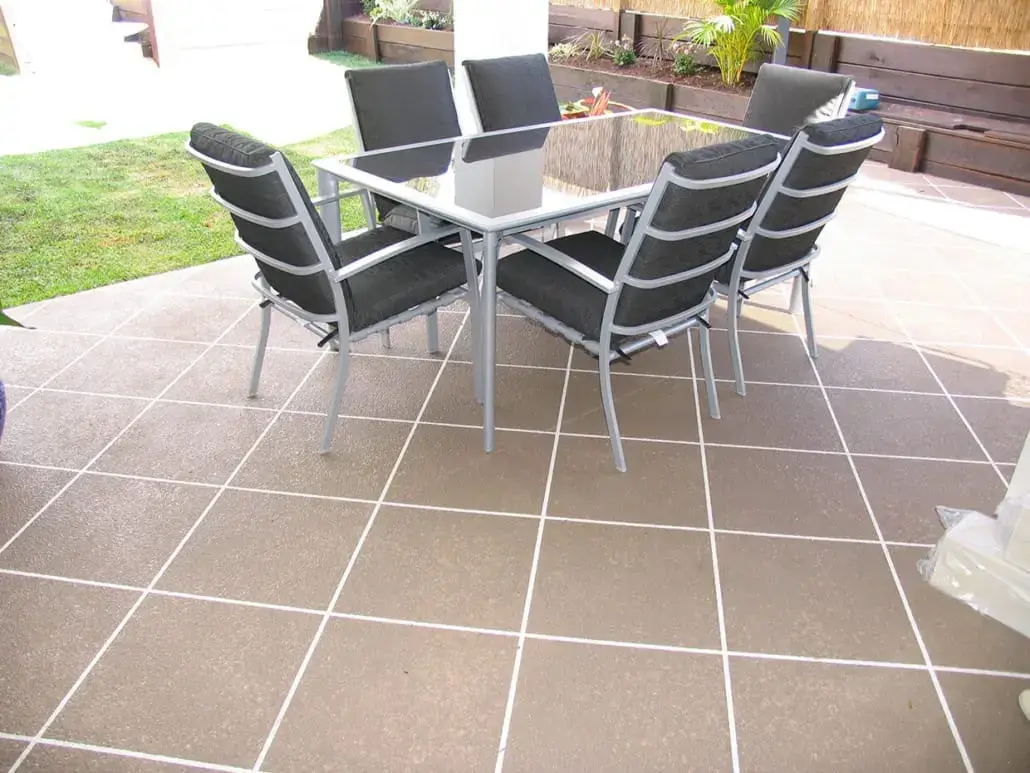
Diamond tile patio
One of the finishes we lay in Ashgrove. Samples come to the quote so you can see it against your own brick and render.
Photographed on one of our own jobs in South East Queensland — not a stock image.
What we do here
Ashgrove is dominated by two things: gradient and age. The suburb runs up and across a series of ridges, and most of the housing is post-war brick and timber, which puts the original concrete somewhere between sixty and eighty years old.
Old concrete is not automatically bad concrete. Plenty of 1950s Ashgrove driveways are dense, sound and perfectly good substrate. But they were poured to a different standard, they are often thinner than a slab poured today, and they were rarely jointed the way we would joint them now. All three matter before anything gets laid over the top.
- Steep driveways with slip rating set for the fall
- Retaining walls and stair flights
- Post-war driveway and path resurfacing
- Crack repair and joint replacement
- Carport and garage floors
- Drainage corrections before finishing
What the slabs are like in Ashgrove
Gradient changes the finish decision entirely. On a driveway steep enough that you brake on the way down, the surface has to hold grip when wet, which rules out anything with a high-gloss film and pushes the specification toward exposed aggregate or a textured stencil with a matte seal. We rate for the wet condition, not the dry one.
Thin old slabs are the other constraint. An overlay adds a few millimetres of material and a fair amount of grinding beforehand, and there is a point where a slab has too little cover left to take it. We test-grind a small area at the quote so the answer comes from the slab rather than from optimism.
Ashgrove also sits on reactive soils with a lot of cut-and-fill from the original subdivision. Movement cracking along old fill lines is common, and it determines whether a crack gets bridged, cut out, or left as an honest joint in the new surface.
Licensed concreting contractor, fully insured.
On site, with the slab tested before anyone quotes a finish.
Foot traffic at 24 hours, vehicles at 72 on most finishes.
Brisbane, Ipswich, Logan, Redlands and both coasts.
How we schedule Ashgrove work
Steep sites take longer and need to be sequenced around vehicle access, because on most Ashgrove blocks there is exactly one way in and it is the thing being resurfaced. We stage the work so you are not stranded, which usually means doing a driveway in halves.
Cure times are non-negotiable on a grade. Foot traffic at 24 hours and vehicles at 72 is the general rule, but on a steep drive we would rather you wait the extra day than mark a fresh surface pulling in.
Services in this area
What goes down most often here
Exposed aggregate
Washed back to reveal the stone. The South East Queensland driveway default, and the most forgiving surface underfoot.
See finishStencilled concrete
A paper stencil laid into the colour coat, sprayed over and lifted — leaving pattern joints in a second colour.
See finishColoured concrete
Full-strength oxide colour, with or without a cut pattern. Reads terracotta against brick and charcoal against render.
See finishThe questions we get asked in Ashgrove
My driveway is steep. Which finish is safest?
Exposed aggregate or a textured pattern with a matte seal. We specify to the wet slip rating, not the dry one, and put the rating on the quote.
The driveway is from the 1950s. Is it too old to resurface?
Age is not the problem — remaining thickness and soundness are. We test-grind a patch at the quote and tell you honestly if it needs replacing instead.
Where will we park while you work?
We stage steep driveways in halves so there is always a way in or out. It adds a day and we build it into the quote.
Can you fix the retaining wall at the same time?
Often yes. Retaining and stairs are part of what we do, and doing them in the same visit avoids grinding a finished surface twice.
Worth reading first
Others in Brisbane City
Send a photo of the slab.
We will tell you whether it can be resurfaced, what finish suits it, and what it costs — before anyone turns up with a grinder.