Centenary Heights is established post-war and mid-century housing on deep reactive black soil. Recurring cracks along the same lines are the signature local problem, and they are a joint issue rather than a surface one. Frost and wide temperature swings still apply at this altitude.
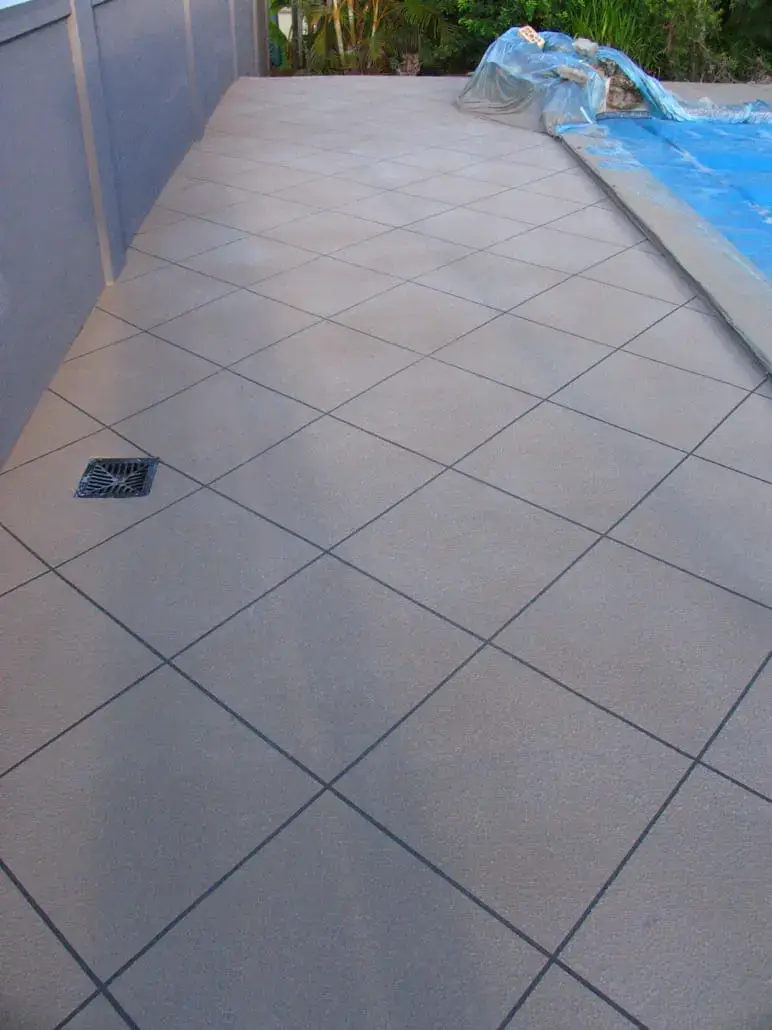
Hexagon path to a pool surround
One of the finishes we lay in Centenary Heights. Samples come to the quote so you can see it against your own brick and render.
Photographed on one of our own jobs in South East Queensland — not a stock image.
What we do here
Centenary Heights is settled Toowoomba — post-war and mid-century housing on regular blocks, with concrete that in many cases predates current slab practice by decades.
The recurring conversation here is cracking. Owners have usually filled the same crack two or three times and want to know why it keeps coming back. The answer is almost always that it is not a crack, it is an unrelieved joint in soil that moves a great deal.
- Crack assessment and joint replacement
- Established driveways and paths
- Garage floors in vinyl flake or epoxy
- Patios and covered areas
- Frost-tolerant sealer specification
- Retaining and garden edging
What the slabs are like in Centenary Heights
Black soil defines the engineering problem. Vertosol clay swells substantially when wet and shrinks when dry, and that movement transfers into anything sitting on it. A slab on reactive clay will move seasonally whether convenient or not, and the only real control is deciding where. Properly placed and maintained control joints do that; filling and covering does not.
Older slabs here were poured thinner and often without adequate reinforcement. Many are sound; some are not. We test-grind at the quote rather than promising a finish and discovering the problem afterwards.
Altitude adds frost cycling and wide daily temperature ranges, which favour low-porosity, mechanically bonded finishes and flexible sealers over thin decorative films.
Licensed concreting contractor, fully insured.
On site, with the slab tested before anyone quotes a finish.
Foot traffic at 24 hours, vehicles at 72 on most finishes.
Brisbane, Ipswich, Logan, Redlands and both coasts.
How we schedule Centenary Heights work
Range work is grouped into planned runs, so expect a firm date rather than a same-week start. There is no travel premium on the rate.
Where the assessment shows a slab moving too much to carry an overlay, we say so and requote it as repair or replacement. On reactive soil that is a more common answer than in most areas.
Services in this area
What goes down most often here
Exposed aggregate
Washed back to reveal the stone. The South East Queensland driveway default, and the most forgiving surface underfoot.
See finishFlake flooring
Vinyl flake broadcast into resin and sealed. The garage and laundry floor that hides dust and shrugs off tyre marks.
See finishCovercrete / Covacrete
A trowelled cement overlay stamped or stencilled into pattern. Two to four millimetres over a sound slab.
See finishThe questions we get asked in Centenary Heights
We have filled the same crack three times. Why does it return?
Because it is a joint, not a crack. On black soil the slab has to move somewhere, and until it has a proper control joint it will keep moving at that line.
Can you resurface over a crack that is still moving?
No. It telegraphs straight through. It gets cut out and re-formed as a joint first, or the answer is replacement.
Epoxy or flake for the garage floor?
Flake, more often than not, in this climate — it tolerates movement and hides dust and tyre marks better than a plain epoxy film.
Does the altitude change the specification?
Yes. Frost cycling and wide daily temperature swings favour low-porosity finishes and flexible sealers.
Worth reading first
Others in Toowoomba
Send a photo of the slab.
We will tell you whether it can be resurfaced, what finish suits it, and what it costs — before anyone turns up with a grinder.