Car park and hardstand resurfacing
Ramps, aprons and bays — resurfaced in sections so the car park keeps taking cars.
Car park resurfacing is specified by where the traffic turns and brakes, not by appearance. Ramps get a coarse mechanically keyed slip-resistant finish; flat bays get a hard-wearing sealed surface; line marking is set out and reinstated as part of the program. Work is staged in sections so the car park never fully closes.
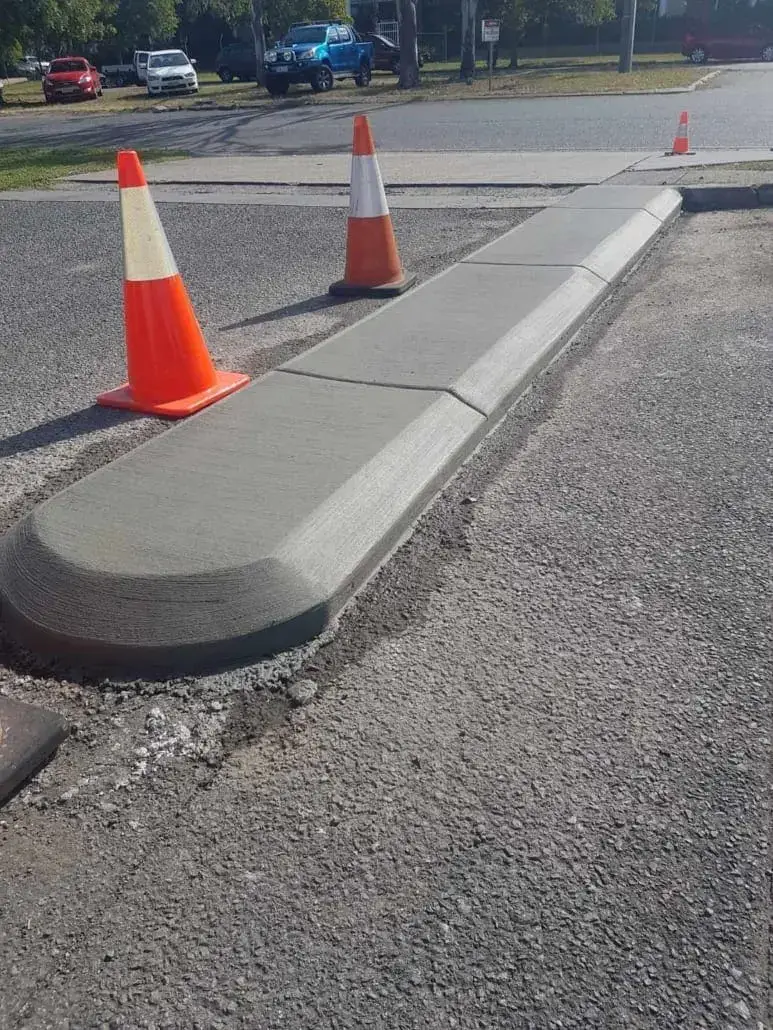
Car park islands and kerbs
Formed, poured and finished in sections so the car park keeps operating.
Photographed on one of our own jobs in South East Queensland.
What this covers
A car park is not one surface, it is three or four with different problems. The ramp is steep, often wet, and worked by tyres scrubbing at low speed. The turning areas take the most punishment. The flat bays are comparatively easy. The apron at the entry takes every vehicle that uses the site.
We specify each zone against what happens on it. That is why a car park quote from us reads as several line items rather than a single rate per square metre.
- Basement and external ramps
- Turning areas and circulation aisles
- Parking bays and visitor bays
- Entry aprons and crossovers
- Loading docks and service areas
- Line marking, arrows and hatching
Ramps are the hard part
A ramp fails first and it fails worst, because it combines gradient, water and scrubbing tyres. Decorative finishes do not belong on one. We specify a coarse, mechanically keyed slip-resistant surface, and we state the rating in writing rather than describing it as non-slip and leaving it there.
Where a ramp is already failing at the edges, the cause is usually a joint seal that has gone and let water in under traffic. That gets addressed before anything is laid, otherwise the same failure works its way up through the new surface.
Line marking is part of the job
Resurfacing removes the line marking, so reinstating it accurately is part of the program rather than someone else's problem. Bays, arrows, hatching, disabled bays and no-stopping zones are set out from the existing layout — or from a revised layout if the site is being reconfigured at the same time, which is worth considering while the surface is already off.
Accessible bay dimensions and markings have compliance requirements, and we set them out to the standard rather than copying whatever was there before, which is frequently wrong.
Staging a car park that cannot close
Almost no car park can shut for a week. We section the work so a proportion of bays and at least one circulation route stay open throughout, and we agree the sequence and the signage in writing before mobilising.
Where a ramp is the only access, that section is done overnight or across a weekend, because there is no way to stage a single ramp in halves and keep it usable.
The questions we get asked
Can the car park stay open?
Yes, in sections. We keep bays and at least one circulation route open throughout and agree the staging and signage before starting. A single-access ramp is the exception — that gets done overnight or on a weekend.
What finish goes on the ramp?
A coarse, mechanically keyed slip-resistant finish with the rating stated in writing. Gradient plus water plus scrubbing tyres rules out decorative surfaces.
Do you reinstate the line marking?
Yes, as part of the program. We set out to standard rather than copying the previous layout, which is often non-compliant on accessible bays.
The ramp edges are crumbling. Is that a resurfacing job?
Usually it is a failed joint seal letting water in under traffic. That gets fixed first or the same failure comes through the new surface.
How long before vehicles can use it?
72 hours on most finishes. We stage so that never means the whole car park at once.
Other commercial work
Worth reading first
Send a photo of the slab.
We will tell you whether it can be resurfaced, what finish suits it, and what it costs — before anyone turns up with a grinder.