Holland Park is post-war housing on hilly ground, so driveways are short and steep and a lot of the concrete sits under the house. Slabs are often sixty years old and thinner than current practice. Slip rating and remaining slab thickness are the two things that decide what is possible.
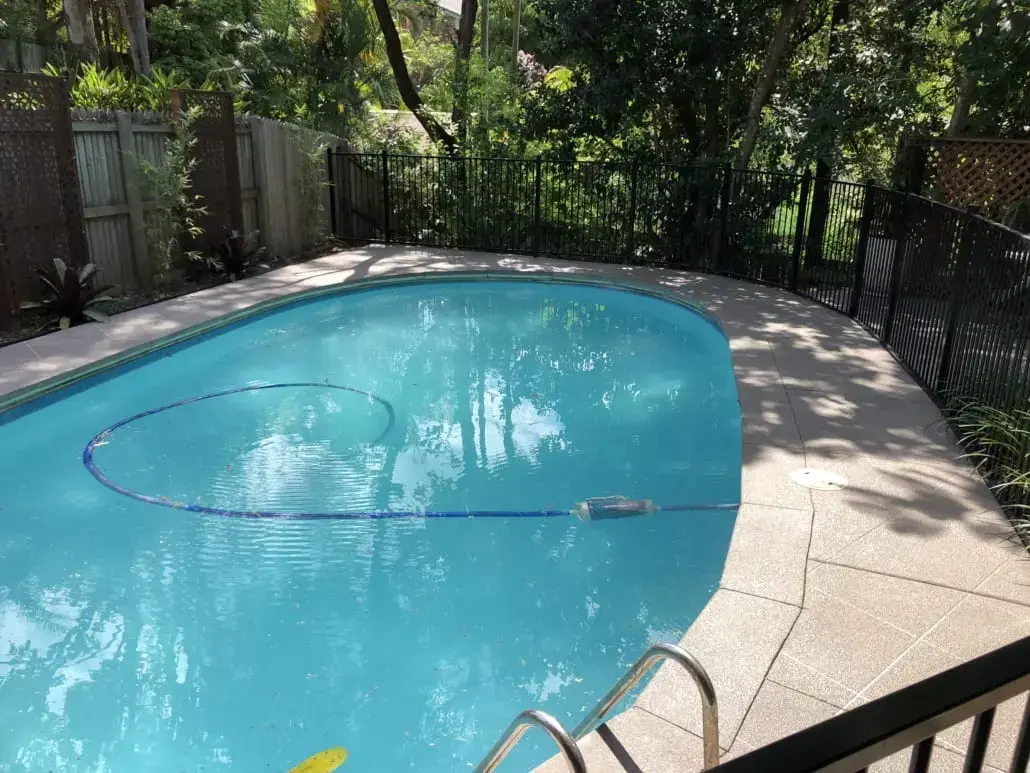
Coloured overlay pool surround
One of the finishes we lay in Holland Park. Samples come to the quote so you can see it against your own brick and render.
Photographed on one of our own jobs in South East Queensland — not a stock image.
What we do here
Holland Park runs across a series of ridges, and the housing is mostly post-war brick and timber. That puts the original concrete somewhere between sixty and seventy-five years old, and it puts most driveways on a real grade over a short run.
A short steep driveway is a specific problem. There is no room to ease the gradient, the crossover is usually the steepest part, and the surface has to grip when wet or the car slides on the way down.
- Steep short driveways and crossovers
- Under-house and carport slabs
- Stair flights and landings
- Retaining walls
- Crack repair and joint replacement
- High slip-rating finishes
What the slabs are like in Holland Park
Remaining thickness is the first constraint. Post-war slabs were poured thinner, and an overlay needs grinding beforehand — there is a point where a slab has too little cover left to take it. We test-grind a patch at the quote rather than promising a finish and finding out later.
Under-house slabs are frequently damp. They sit low, often with no membrane, and they draw moisture from the ground indefinitely. Film sealers blister on those; penetrating sealers let the slab breathe. This is one of the more common specification mistakes we are called to fix.
Gradient sets the slip rating. Anything above a gentle fall gets a textured finish and a matte seal, rated for the wet condition rather than the dry.
Licensed concreting contractor, fully insured.
On site, with the slab tested before anyone quotes a finish.
Foot traffic at 24 hours, vehicles at 72 on most finishes.
Brisbane, Ipswich, Logan, Redlands and both coasts.
How we schedule Holland Park work
Steep sites are staged around vehicle access, because on most Holland Park blocks the driveway is the only way in. We do them in halves and hold the cure times — on a steep drive we would rather you wait a day than mark a fresh surface.
Access for plant is variable. Where we cannot get a machine down, smaller equipment and barrow runs do the work, priced honestly.
Services in this area
What goes down most often here
Exposed aggregate
Washed back to reveal the stone. The South East Queensland driveway default, and the most forgiving surface underfoot.
See finishCovercrete / Covacrete
A trowelled cement overlay stamped or stencilled into pattern. Two to four millimetres over a sound slab.
See finishColoured concrete
Full-strength oxide colour, with or without a cut pattern. Reads terracotta against brick and charcoal against render.
See finishThe questions we get asked in Holland Park
Our driveway is short and very steep. What is safe?
A textured finish with a matte seal, rated for the wet condition. Gloss on a grade this steep is a genuine hazard.
The slab is from the 1950s. Is it too thin?
Sometimes. We test-grind at the quote and tell you if replacement is the better spend rather than promising an overlay.
The under-house slab is always damp. Can it be sealed?
With a penetrating sealer, yes. A film sealer over a damp slab will blister — that is the usual reason these fail.
Where do we park during the work?
We stage steep driveways in halves so there is always a way in or out. It adds a day, built into the quote.
Worth reading first
Others in Brisbane Southside
Send a photo of the slab.
We will tell you whether it can be resurfaced, what finish suits it, and what it costs — before anyone turns up with a grinder.